
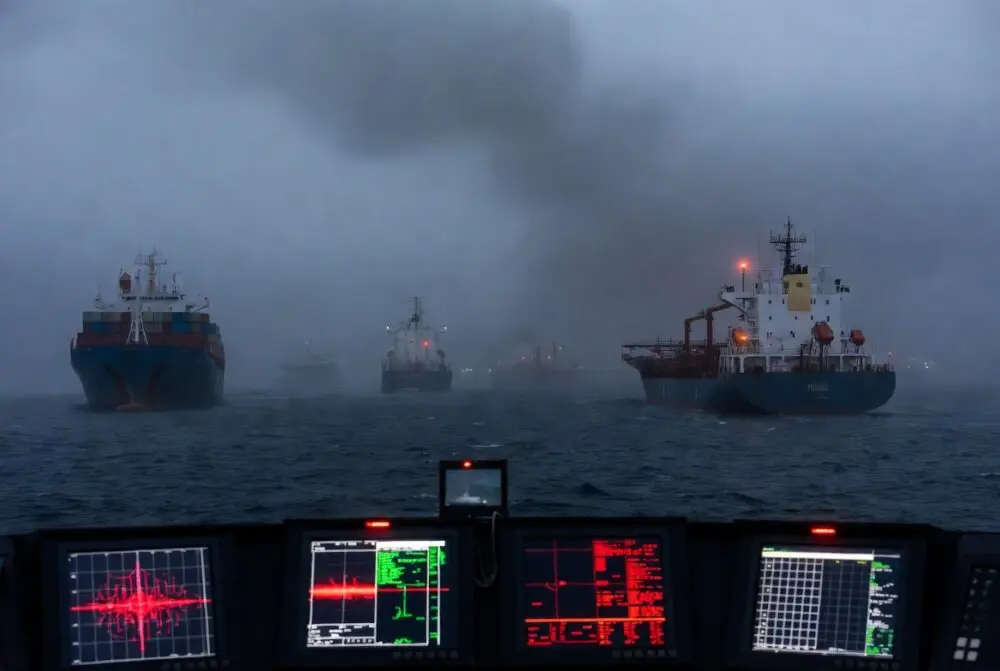
For decades, the modern supply chain has relied on a silent utility: the Global Positioning System (GPS). From a container ship in the Red Sea to a delivery truck crossing the Jordanian border, real-time visibility has been the backbone of “just-in-time” logistics.
However, as conflict intensifies across the Middle East, that visibility is being extinguished. An “invisible battle” of signal interference is creating an electronic fog, leaving cargo moving through the region effectively blind—and making shipment tracking a nightmare for global logistics providers
1. The Disappearance of Real-Time Visibility
In the logistics world, data is king. Freight forwarders and clients expect to see their cargo move in real-time on a digital map. But in parts of the Eastern Mediterranean, the Red Sea, and the Persian Gulf, GPS signals are being “jammed” (blocked entirely) or “spoofed” (tricked into showing the wrong location).
For cargo tracking, this means a shipment currently in a port in Israel or Lebanon might suddenly appear on a tracker as being located at Cairo International Airport. This “location shifting” makes it impossible for dispatchers to provide accurate ETAs, leading to massive administrative backlogs and missed delivery windows.
2. Maritime Chaos in the Red Sea and Suez
The maritime sector is the hardest hit. Most cargo ships use the Automatic Identification System (AIS) to signal their position for safety and tracking. AIS relies heavily on GPS.
As ships navigate the volatile waters near Yemen or the Israeli coast, electronic interference causes “ghosting.” A ship carrying thousands of containers may “disappear” from tracking software for days at a time. This lack of data doesn’t just frustrate customers; it creates a massive security risk. Without reliable GPS, ships are more vulnerable to navigation errors in narrow channels and have a harder time signaling for help if they are intercepted or attacked.
VENDOR SELECTION CRITERIA
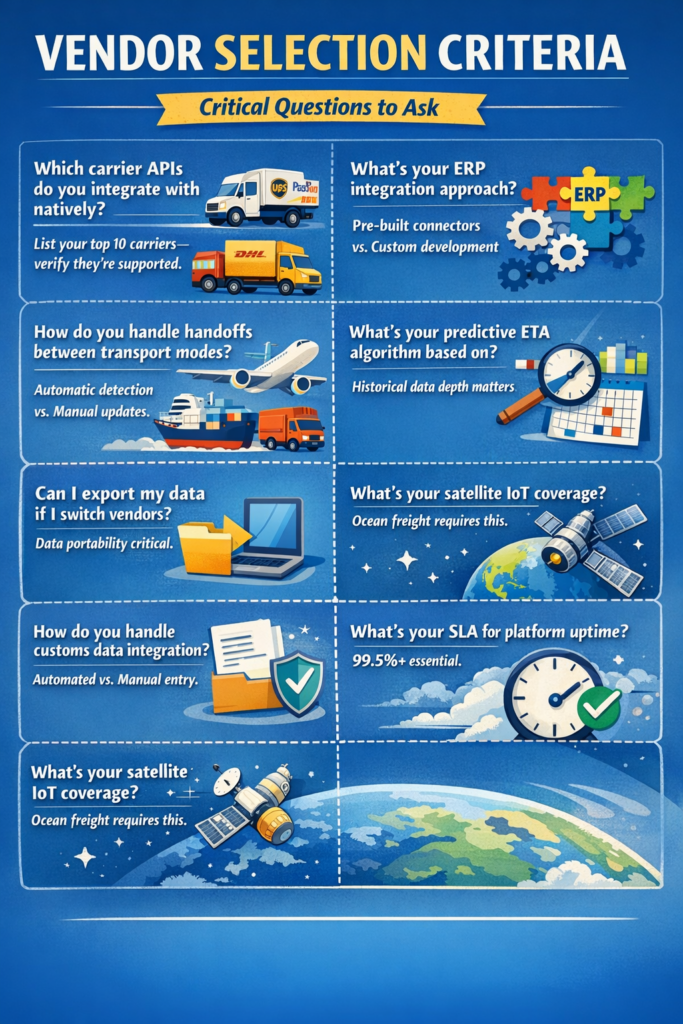
Find out more about selecting vendors in our new 2026 guide to visibility platforms.
Based on 20+ years experience of implementing 100s of GPS tracking projects, and IOT temperature monitoring systems we have written this easy-to-read best practice guide and checklist to help you plan and implement GPS tracking and realtime visibility solutions.
Download Your Free 2026 Guide Here
3. Land Logistics: The Tracking Gap
The impact extends inland to the trucking industry. High-value cargo—electronics, pharmaceuticals, and machinery—moving through Jordan, Turkey, and Iraq relies on GPS-enabled telematics to prevent theft and monitor transit.
When jamming occurs, “geofencing” security measures—which trigger alarms if a truck deviates from its route—become useless. If a truck’s GPS signal is spoofed, the central office may believe the cargo is safely on the highway when, in reality, it could be miles away or stalled at a dangerous border crossing. This forces logistics companies to revert to “manual” tracking—drivers calling in via satellite phones—which is slow, prone to error, and expensive.
4. The Port Bottleneck
The disruption doesn’t end at sea or on the road; it infiltrates the ports themselves. Modern “Smart Ports” use GPS to coordinate the movement of automated gantry cranes and container-stacking vehicles.
When signal interference bleeds into port environments, the automated systems that locate and move specific containers can fail. If a terminal’s tracking system cannot pinpoint a container’s exact location due to GPS instability, the result is a “logistics heart attack”—containers sit idle while crews manually search for them, leading to port congestion that ripples across the global economy.
5. The Economic Cost of Uncertainty
For the global consumer, the “invisible battle” means higher prices. When GPS tracking fails, insurance premiums for cargo in the Middle East skyrocket. Shipping companies must add “war risk” surcharges and factor in the cost of delays caused by manual navigation and lost visibility.
Logistics providers are now scrambling for alternatives. We are seeing a sudden resurgence in “dead reckoning” navigation and the adoption of multi-constellation receivers that try to use European (Galileo) or Chinese (BeiDou) satellites to bypass the jamming—though even these are proving vulnerable.
The Antidote: Why Resilient Tracking is No Longer Optional
In this “GNSS-denied” environment, standard off-the-shelf GPS trackers are becoming liabilities. However, the technology has evolved to meet the threat. Logistics leaders are no longer asking if they should track, but how they track.
To maintain visibility in the Middle East, the industry is moving toward Resilient PNT (Positioning, Navigation, and Timing). This isn’t just “GPS”; it’s a multi-layered shield that includes:
Multi-Constellation Support: Our latest units don’t just rely on US GPS. They jump between Galileo (EU), GLONASS (Russia), and BeiDou (China) to find the cleanest signal.
Jamming Detection & Alerts: Instead of just “going dark,” professional trackers now detect the interference itself and send an immediate “Jamming Alert” via cellular or satellite backup, acting as an early warning system for potential theft.
LEO Satellite Integration: By utilizing Low Earth Orbit (LEO) satellites like Iridium, tracking signals are now up to 1,000x stronger than traditional GPS, cutting through the electronic fog that blinds standard devices.
Inertial Dead Reckoning: When the sky goes dark, the hardware’s internal sensors take over, calculating position based on speed and direction to ensure the “breadcrumb trail” never breaks.where the map no longer matches the terrain.
The New Reality of Logistics
For the shipment and cargo industry, the message is clear: the era of “perfect visibility” is over in the Middle East. As long as the electronic warfare continues, the global supply chain will have to learn to navigate a world where the map no longer matches the terrain.