


Enterprise asset tracking requires matching technology capabilities to operational requirements preventing £200,000-£800,000 stranded investments from wrong technology selection. GPS tracking excels at outdoor transportation visibility but fails indoors. RFID provides checkpoint verification without batteries but cannot track assets between checkpoints. BLE (Bluetooth Low Energy) enables indoor positioning with multi-year battery life but requires infrastructure investment. This framework provides decision criteria across accuracy requirements, read range, battery life, environmental conditions, and total cost of ownership enabling optimal technology selection for logistics, manufacturing, healthcare, and retail applications.
What fundamental technical differences separate GPS, RFID, and BLE technologies?
GPS (Global Positioning System) triangulates position from satellite signals providing outdoor location accuracy 5-10 meters consuming 50-200mW power continuously. Devices require clear sky visibility losing signal indoors, underground, or within dense urban environments creating 30-60 minute blind spots during warehouse handling or indoor manufacturing. Battery-powered GPS trackers operate 3-7 days between charges versus 2-5 years for passive tracking alternatives, creating operational overhead from weekly charging requirements unsuitable for high-volume applications exceeding 5,000 tracked assets.
RFID (Radio Frequency Identification) uses electromagnetic fields enabling passive tags operating without batteries by harvesting energy from reader signals. Passive UHF RFID achieves 3-8 meter read range through doorway portals automatically scanning 200-400 tags simultaneously as assets pass through checkpoints. Active RFID incorporating batteries extends read range to 30-100 meters enabling real-time location within buildings but increases per-tag cost from £0.15-0.40 (passive) to £25-60 (active) limiting economic viability to high-value assets or smaller populations.
BLE (Bluetooth Low Energy) beacons transmit signals received by fixed gateways triangulating position within indoor environments. Zone-level accuracy (10-15 meters) identifies assets within specific warehouse aisles, hospital wards, or manufacturing work cells without requiring GPS satellite visibility. Battery life of 2-5 years enables deployment across 10,000+ asset populations with annual maintenance replacing exhausted beacons rather than weekly charging. Infrastructure investment of £40,000-£120,000 per 50,000 sq ft facility represents upfront cost absent from GPS solutions but eliminates ongoing battery management labor.
Which technology suits different supply chain visibility requirements?
Use Case | Optimal Technology | Accuracy Required | Cost per Asset | Why This Technology |
Fleet vehicle tracking | GPS + Cellular | 5-10 meters | £200-400 | Outdoor road/route visibility |
Hospital equipment | BLE beacons | 10-15 meters | £20-50 | Indoor ward/bay location |
Retail tote pools | Passive RFID | Checkpoint only | £0.15-0.40 | High volume, low value |
Manufacturing WIP | UWB (not BLE) | 10-30 cm | £100-300 | Workstation-level precision |
International shipping | GPS + Satellite IoT | 5-10 meters | £150-400 | Ocean freight visibility |
Construction equipment | GPS + Cellular | 5-10 meters | £150-350 | Theft prevention across sites |
Technology selection depends primarily on indoor versus outdoor operational environment. GPS requires outdoor deployment with satellite visibility making it unsuitable for warehouse equipment, hospital assets, or manufacturing WIP spending majority of lifecycle indoors. BLE and RFID dominate indoor applications with selection between them determined by whether continuous real-time location or periodic checkpoint verification satisfies operational requirements.
VENDOR SELECTION CRITERIA

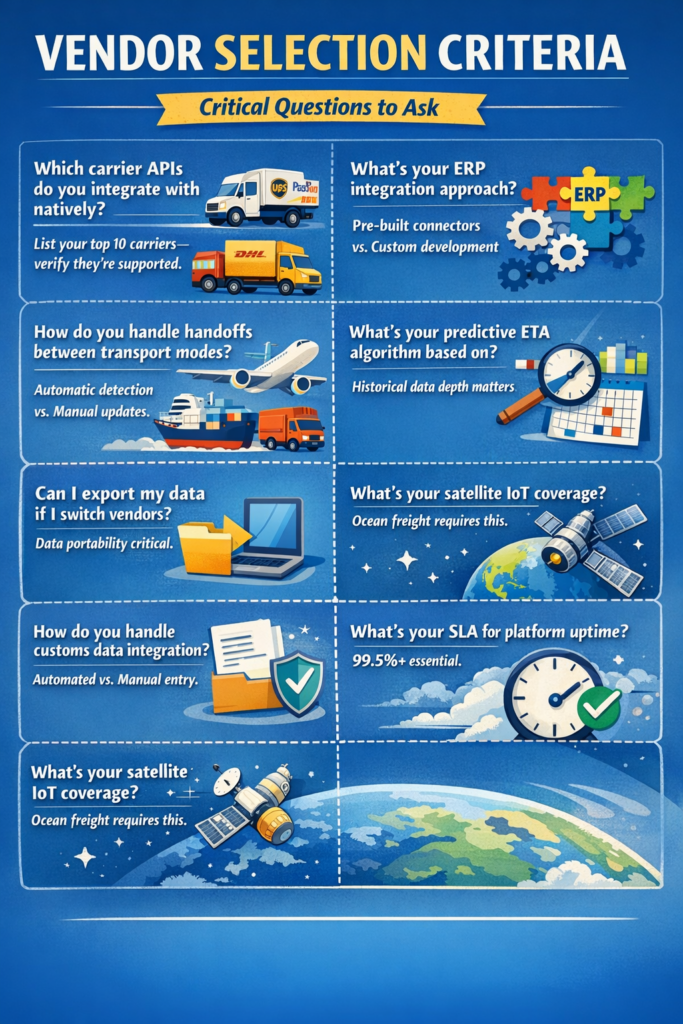
Find out more about selecting vendors in our new 2026 guide to visibility platforms.
Based on 20+ years experience of implementing 100s of GPS tracking projects, and IOT temperature monitoring systems we have written this easy-to-read best practice guide and checklist to help you plan and implement GPS tracking and realtime visibility solutions.
Download Your Free 2026 Guide Here
When does passive RFID deliver better ROI than GPS or BLE?
High-volume low-value asset populations favor passive RFID economics. Retail grocers tracking 500,000-3M plastic totes worth £8-15 each cannot justify £20-50 BLE beacons or £200-400 GPS trackers exceeding container value. Passive RFID tags at £0.15-0.40 scale economically across massive populations where aggregate tracking investment remains below total asset value. Tag lifespan of 8-12 years surviving 1,000+ wash cycles eliminates battery replacement overhead inherent in active technologies.
Checkpoint-based workflows suit passive RFID without requiring continuous location visibility. Distribution centers processing inbound/outbound shipments through loading dock portals automatically scan RFID tags as trucks arrive and depart. This checkpoint model captures 90% of operational value (verifying receipt and dispatch) without infrastructure investment for continuous indoor positioning. Unlike BLE requiring gateway installation throughout facilities, RFID portals concentrate at 5-15 strategic chokepoints reducing hardware cost 60-80%.
Harsh environments favor passive RFID durability. Metal manufacturing, chemical processing, and food production expose tracking devices to temperature extremes (-40°C to +85°C), moisture, chemicals, and physical impact destroying battery-powered electronics. Passive RFID tags containing no batteries or active components survive conditions degrading GPS and BLE devices within 6-18 months. Automotive manufacturers embedding RFID in engine blocks, transmission assemblies, and body panels demonstrate technology robustness unmatched by battery-dependent alternatives.
What operational scenarios justify BLE investment over passive RFID?
Real-time location requirements eliminate RFID from consideration. Hospital equipment tracking requires knowing wheelchair locations within 30 seconds when ward nurse needs patient transport. RFID checkpoint scanning discovering wheelchair location during last portal passage (potentially 8-12 hours prior) provides insufficient operational value. BLE updating position every 15-60 seconds enables staff locating equipment within 2-3 minutes versus 20-35 minute manual searching, justifying £40,000-£80,000 infrastructure investment across 50,000 sq ft hospital.
Search time reduction drives BLE ROI in warehouse and manufacturing environments. Operations spending £200,000-£600,000 annually on labor searching for forklifts, pallet jacks, and mobile equipment achieve 65-75% search time reduction through zone-level BLE positioning. Unlike RFID requiring operators walking to designated readers for scanning, BLE provides location visibility from any networked device enabling dispatchers directing operators to nearest available equipment without physical asset verification.
Security and theft prevention applications require continuous monitoring impossible with checkpoint RFID. High-value pharmaceutical inventory, aerospace components, and prototype products justify BLE geofence alerts triggering when assets exit authorized zones. This proactive security prevents £50,000-£500,000 losses from internal theft, competitor espionage, or unauthorized disposal operating hours or days before discovery through periodic RFID audits.
Why do international shipments require GPS despite indoor alternatives?
Multi-modal transportation crosses technological boundaries requiring universal outdoor positioning. Containers moving ocean freight → rail → truck traverse environments where BLE infrastructure (ports, rail yards, distribution centers) exists intermittently but GPS provides continuous visibility. Unlike domestic logistics operating within single-country infrastructure enabling coordinated BLE/RFID deployment, international shipping spans 50-150 entities (carriers, ports, customs facilities) preventing technology standardization making GPS the only universally compatible solution.
Customs and border security mandate independent verification separate from carrier-provided tracking. Importers cannot rely on shipping line ETA estimates or carrier EDI messages for high-value pharmaceutical, electronics, or perishable cargo. GPS trackers providing independently-verified position data enable proactive customs clearance preparation, temperature excursion investigation, and demurrage dispute resolution. This independence justifies £150-400 per-shipment GPS cost for containers valued £100,000-£2M where 12-hour arrival time inaccuracy causes £15,000-£50,000 operational disruption.
Insurance and liability requirements increasingly mandate GPS verification for high-value cargo. Marine cargo insurers offer 5-15% premium reductions for GPS-tracked shipments enabling theft recovery, hijacking investigation, and environmental compliance documentation. One electronics importer reduced annual insurance costs £180,000 (from £1.2M to £1.02M premium on £80M annual imports) through GPS tracking demonstrating improved cargo security and temperature monitoring compliance.
How do hybrid GPS + RFID/BLE solutions address multi-environment tracking?
Dual-mode tags switching between GPS (outdoor) and BLE (indoor) eliminate visibility gaps during mode transitions. Pharmaceutical cold chain logistics requires continuous monitoring from manufacturing through distribution to hospital pharmacy spanning outdoor transportation and indoor warehouse handling. Hybrid trackers transmitting GPS coordinates during transit then switching to BLE positioning within distribution centers provide seamless visibility preventing 4-8 hour blind spots during intermodal transfers where single-technology solutions lose tracking.
Cost optimization deploys GPS on returnable transport equipment with passive RFID on contained goods. Automotive manufacturers tracking returnable pallets and bins use £80-150 GPS devices on €800-2,500 transport equipment while passive £0.20-0.40 RFID tags identify individual component assemblies. This hierarchical tracking captures container location through GPS enabling pallet recovery and theft prevention, while RFID verifies contents preventing mix-ups and quality issues, at combined cost 70-80% below tagging every component with GPS.
Network infrastructure investment determines technology selection more than per-tag costs. Organizations with existing WiFi networks favor BLE leveraging installed infrastructure requiring only beacon/gateway additions costing £40,000-£120,000 per 50,000 sq ft. Facilities without comprehensive WiFi coverage face £150,000-£300,000 network upgrades before BLE deployment, potentially making RFID portal-based solutions (£30,000-£60,000 per facility) more economically viable despite inferior real-time visibility.
What decision criteria determine optimal technology selection?
- Asset value: <£50 → Passive RFID | £50-500 → BLE beacons | >£500 → GPS trackers
- Population size: >100,000 assets → RFID scales best | 1,000-100,000 → BLE viable | <1,000 → GPS manageable
- Operational environment: 80%+ outdoor → GPS mandatory | 80%+ indoor → BLE/RFID | Mixed → Hybrid solutions
- Location accuracy: Checkpoint verification → RFID sufficient | Zone-level (10-15m) → BLE | Precise (<1m) → UWB required
- Update frequency: Daily acceptable → RFID | Hourly required → BLE | Real-time critical → GPS/Active RFID
- Battery management: Zero tolerance → Passive RFID | Acceptable with procedures → BLE | Dedicated charging staff → GPS
- Infrastructure readiness: Existing WiFi → BLE favored | No network → RFID portals | Outdoor only → GPS cellular
- Environmental conditions: Harsh (temperature/chemical) → Passive RFID | Moderate indoor → BLE | Outdoor weather → GPS
Common technology selection mistakes and their consequences
GPS deployment for predominantly indoor applications represents most frequent stranded investment. Manufacturers installing £200-400 GPS trackers on equipment operating 80% of time inside factories discover tracking goes dark during production hours providing visibility only during outdoor storage or transport between buildings. This mistake costs £150,000-£500,000 across 1,000-2,000 asset deployments requiring complete technology replacement with BLE/RFID solutions. Prevention requires honest assessment of indoor versus outdoor operational time before technology selection.
Passive RFID selection for real-time visibility requirements creates operational failures. Healthcare organizations implementing RFID expecting continuous equipment location discover checkpoint-based visibility provides insufficient operational value when staff need immediate location not last-seen timestamp from 8 hours prior. This misalignment requires £100,000-£300,000 additional investment in BLE infrastructure or operational workarounds diminishing original business case. Success requires defining ‘visibility’ as checkpoint verification versus continuous real-time positioning before vendor evaluation.
BLE deployment without adequate WiFi coverage produces unreliable positioning and staff frustration. Facilities attempting BLE tracking across warehouses with 40-60% WiFi coverage experience dead zones where assets disappear for hours until entering covered areas. Resulting location uncertainty undermines staff confidence abandoning technology within 6-12 months. Site surveys using WiFi heatmapping tools prevent this failure by identifying coverage gaps requiring remediation before BLE deployment rather than discovering deficiencies post-installation.
Technology selection roadmap for enterprise deployments
- Week 1-2: Operational assessment – indoor/outdoor time split, accuracy requirements, update frequency needs
- Week 3-4: Infrastructure audit – WiFi coverage mapping, loading dock chokepoint identification, cellular connectivity testing
- Week 5-6: Pilot planning – select 50-200 representative assets across operational environments for technology validation
- Week 7-10: Parallel pilots – deploy GPS, RFID, and BLE simultaneously on different asset types measuring performance
- Week 11-12: Results analysis – compare location accuracy, update frequency, operational usability, total cost
- Week 13-16: Final technology selection and vendor negotiation based on validated pilot performance data
Resource requirements: Operations manager (20% FTE for pilot coordination), IT infrastructure specialist (15% FTE for network assessment), Finance analyst (10% FTE for TCO modeling). Parallel pilots cost £30,000-£60,000 but prevent £200,000-£800,000 wrong-technology stranded investments making upfront validation highly cost-effective.
Strategic Tracking provides vendor-agnostic technology selection consulting across GPS, RFID, BLE, UWB, and hybrid solutions. Our assessment methodology evaluates operational requirements, infrastructure readiness, and total cost of ownership recommending optimal technology combinations rather than single-vendor solutions. We manage parallel pilot programs validating technology performance before full-scale deployment preventing stranded investments from wrong technology selection.