


THE DIGITAL PERIMETER
Welcome to this week’s edition of Tracking Tuesday.
The mid-point of Q2 2026 has brought a sharp expansion of what we define as the “Information Perimeter.” We are no longer merely tracking physical steel containers across oceans or highways. The intelligence gathered over the last 72 hours proves that your primary logistical vulnerability is now the digital and regulatory interface.
From corporate identity laundering on domestic spot markets to critical third-party API blind spots and rigid international air freight validations, secure visibility is now your primary defense mechanism against total systemic breakdown.
Identity Laundering: The Highway Freight Fraud Escalation
On May 18, 2026, the updated Highway Freight Fraud Index revealed an unprecedented milestone: fraud volume hit an all-time high in Q1 2026, driven by a 169.6% surge in change-of-ownership scams executed via illicit Motor Carrier (MC) authority transfers.
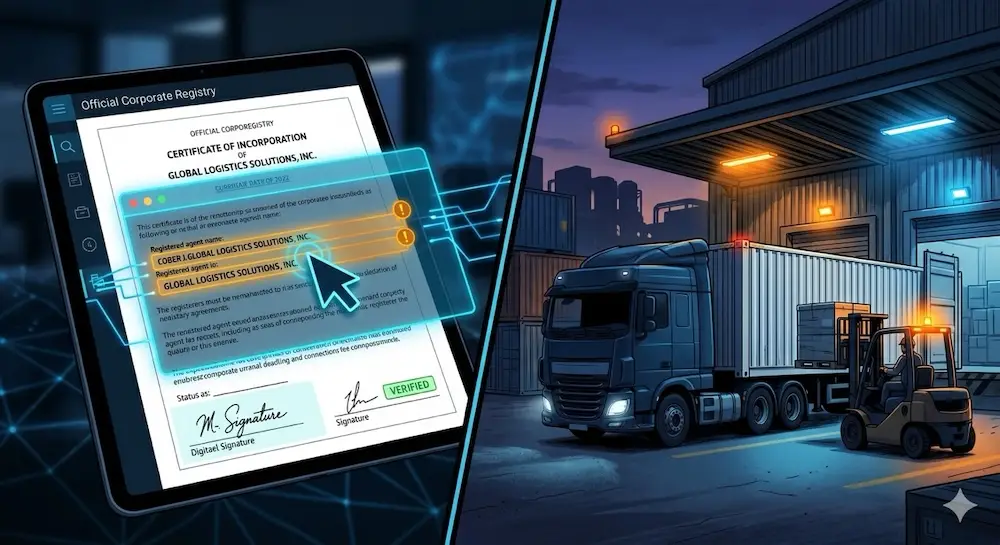
Criminal syndicates have moved beyond simple email spoofing and fake load-board postings. They are now actively purchasing aging, legitimate carrier corporations with pristine safety records and active DOT numbers. Once control is transferred, the entities are used as “Trojan Horses” to win high-value tenders on automated spot markets. Traditional onboarding software that flags newly registered MC numbers fails completely here because the corporate entity itself possesses a years-long history of clean data.
“Fraudsters are weaponizing corporate lineage. By buying existing authorities, they inherit trust digitally while intending physical theft from day one.” — Carrier Vetting Matrix Report, May 2026.
Shippers must immediately integrate corporate registry monitoring into their WMS/TMS onboarding pipelines. If an MC authority experiences a rapid corporate officer change within 60 days of a high-value tender bid, the system must trigger an automatic hold.
Third-Party Exposures: The Supply Chain Cyber-Blindness Crisis
The UK Department for Science, Innovation and Technology (DSIT) and the Home Office jointly published the Cyber Security Breaches Survey 2026 on May 18, 2026. The data reveals a massive security deficit: only 15% of enterprise organizations formally review immediate supplier cyber risks, and a mere 6% evaluate their wider, multi-tier digital chain.
Threat actors are explicitly exploiting this lack of oversight by executing upstream API injections. Rather than attacking a Fortune 500 company’s hardened firewall directly, hackers target the vulnerable web portals and unencrypted tracking tokens of tier-2 and tier-3 logistics providers. A single compromised webhook in a regional carrier’s tracking software can expose real-time location logs, warehouse gate access pin codes, and high-value cargo manifests to malicious actors.
“Organizations cannot secure their data if they treat logistics visibility vendors as passive utilities rather than active network endpoints.” — DSIT/Home Office Joint Advisory.
Moving forward, “Visibility Security” requires a zero-trust architecture. Shippers must require all tracking partners to provide verified SOC 2 Type II certifications and mandate end-to-end encryption on all tracking API integrations.
Supplier Quick Quotation Request
Compliance Friction: EU Air Cargo EBR Mandates Hit the Runway
Following the final review cycle ending May 17, 2026, European Union customs authorities have initiated strict, unannounced enforcement of upgraded air cargo data protocols, requiring an airtight Established Business Relationship (EBR) validation for all freight inbound to the EU.
The operational penalty for data inaccuracy has officially reached a breaking point. Under the new guidelines, minor data discrepancies on an Air Waybill (AWB)—such as a mismatched postal code or unverified consignee telephone number—no longer just flag a delay; they trigger a mandatory, secondary physical screening protocol. For high-value electronics and temperature-sensitive pharmaceuticals, this shifts processing times from hours to days, frequently overwhelming airport cold-storage capabilities.
“Data hygiene is no longer a back-office administration problem; it is a critical variable governing physical asset velocity.” — European Air Freight Council Q2 Briefing. >
Supply chain VPs must deploy automated data-scrubbing layers that match shipper-provided master data against global trade registries prior to cargo tendering, completely eliminating manual entry errors before air transport manifests are generated.
🌌 Idea for the Future: THE CRYPTOGRAPHIC CHAIN-OF-CUSTODY (C3) PROTOCOL
The Concept: A decentralized, biometric-to-token identity anchor that completely isolates high-value freight from corporate-laundering or spoofing fraud.
How it Works: Rather than relying on a carrier’s MC number or easily duplicated paperwork, the load itself generates a dynamic cryptographic key pair upon tender allocation. To physically accept or move the cargo, the assigned driver must provide a live biometric signature at the gate that matches a zero-knowledge proof (ZKP) identity token on a secure ledger. If the carrier’s corporate ownership shifts, or if the driver’s biometric signature changes mid-route without an authorized, authenticated change-order from the shipper’s TMS, the cargo container’s internal smart lock instantly hardens, and the tracking unit switches to emergency high-frequency satellite pings.
The Strategic Why: This completely removes the human element from carrier verification. Even if a fraud syndicate successfully buys a legacy carrier authority, they cannot generate the matching biometric-cryptographic key needed to unlock or release the physical cargo.
📅 Industry Calendar: Upcoming Events
ASCM Webinar: Turning Friction to Fuel (May 28, 2026 | Virtual): Must-Attend. A deep dive into the Net Zero Logistics/Finmile agentic AI case study.
ASCM & IBF S&OP Conference (June 11–12, 2026 | Chicago, IL): Focus on integrating high-fidelity Henkel packaging data into financial planning.
ASCM Webinar: Agentic AI 101 (July 9, 2026 | Virtual): The tactical roadmap for deploying “Finmile-style” agents in your own fleet.