Strategic Tracking

Multi-Modal Supply Chain Visibility: Tracking Across Road, Rail, Sea & Air

Your subscription could not be saved. Please try again.
Welcome! You will now receive Tracking Tuesday in your inbox.

Tracking Tuesday

Need-to-know tracking news, new IOT devices and connected logistics developments - served every Tuesday.

THE CHALLENGE: VISIBILITY GAPS IN COMPLEX SUPPLY CHAINS

WHAT IS MULTI-MODAL SUPPLY CHAIN VISIBILITY?

Multi-modal visibility platforms combine multiple positioning technologies (GPS, cellular, WiFi, Bluetooth) with integration capabilities across different carriers and logistics partners. Unlike single-mode trackers that work only on trucks or only on ships, these platforms maintain continuous monitoring through:
• Ocean freight (satellite + cellular when in port)

• Air cargo (cellular + airport WiFi networks)

• Rail transport (cellular + geofencing at rail yards)

• Road transport (GPS + cellular)

• Warehouse/facility (WiFi + BLE beacons)

The critical differentiator: data integration. These platforms don’t just track position—they integrate with carrier systems, customs data, and internal ERPs to provide predictive ETAs, exception management, and automated documentation.

TECHNOLOGY ARCHITECTURE: HOW IT WORKS

Hardware Layer:

Modern multi-modal trackers use hybrid positioning:

  • GPS for outdoor positioning (trucks, outdoor rail yards)
  • Cellular (4G/5G) for data transmission globally
  • WiFi triangulation for indoor positioning (warehouses, airports)
  • BLE beacons for precise facility location
  • Satellite IoT (Iridium, Starlink) for ocean/remote coverage
Multi-Modal Supply Chain Visibility: Tracking Across Road, Rail, Sea & Air Strategic Tracking

Software Layer:

Carrier integration APIs (Maersk, MSC, DHL, FedEx)

Customs data feeds (AMS, AES, CHIEF)

ERP connectors (SAP, Oracle, NetSuite)

Predictive ETA algorithms using historical data + real-time inputs

Exception management rules engine

Document generation (bills of lading, customs forms)

Example Workflow

Your subscription could not be saved. Please try again.
Welcome! You will now receive Tracking Tuesday in your inbox.

Tracking Tuesday

Need-to-know tracking news, new IOT devices and connected logistics developments - served every Tuesday.

IMPLEMENTATION CONSIDERATIONS

Data Integration Complexity:

The hard part isn’t hardware it’s connecting to carrier APIs, customs systems, and your ERP. Expect:

  • 2-4 weeks for standard carrier integrations
  • 6-12 weeks for complex ERP integration (SAP especially) 
  • Ongoing maintenance as carrier APIs change

Budget 20-30% of project time for integration vs. hardware deployment.

Connectivity Costs:

Global multi-modal tracking requires expensive connectivity:

  • Cellular roaming: £2-5/device/month
  • Satellite IoT: £8-15/device/month (ocean coverage)
  • Total connectivity: £120-240/device/year

Factor this into TCO calculations—often exceeds hardware cost over 3 years.

Change Management:

Multi-modal platforms require process changes:

  • Carriers must scan/confirm tracker attachment
  • Warehouse teams need new receiving protocols
  • Customer service needs platform training
  • Finance needs integration with billing systems

Training and process documentation often overlooked but critical to ROI.

ROI CALCULATION FRAMEWORK

Benefits:

1. Reduced expedited freight: Proactive exception management avoids costly air freight escalations

2. Lower inventory holding costs: Better ETA accuracy enables JIT receiving

3. Customer retention: Improved OTIF prevents chargebacks and lost business

4. Labor savings: Automated tracking reduces manual carrier calls

5. Insurance premium reduction: Real-time visibility = lower cargo insurance rates

Costs:

1. Hardware: £100-300/device × fleet size

2. Platform subscription: £3,000-15,000/year depending on shipment volume

3. Connectivity: £120-240/device/year

4. Integration: £20,000-80,000 one-time (depending on complexity)

5. Training and change management: £10,000-30,000

**Typical payback: 12-18 months for companies shipping 500+ multi-modal shipments annually**

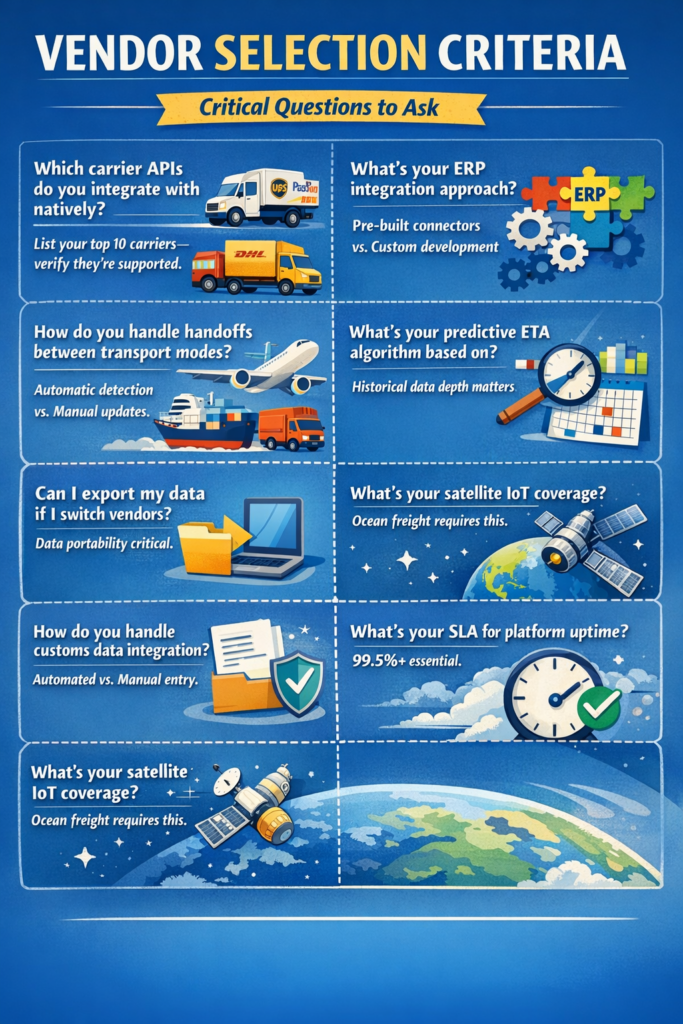
VENDOR SELECTION CRITERIA

Find out more about selecting vendors in our new 2026 guide to visibility platforms.

Based on 20+ years experience of implementing 100s of GPS tracking projects, we have written this easy-to-read best practice guide and checklist to help you plan and implement GPS tracking and realtime visibility solutions.

Download Your Free 2026 Guide Here

FUTURE TRENDS: AI & AUTOMATION

Leading platforms now incorporate:

AI-powered delay prediction:

Machine learning models predict delays 24-48 hours before they occur based on weather, traffic, port congestion

Automated exception resolution:

System automatically books alternative transport when delays detected

Blockchain integration:

Immutable shipment records for customs and compliance

Digital twin simulation:

Model supply chain scenarios before committing to routes

THE BOTTOM LINE

Multi-modal supply chain visibility is essential for global manufacturers and complex logistics operations. The ROI is clear for companies shipping:

  • 500+ multi-modal shipments annually
  • High-value goods (£20k+ per shipment)
  • Time-sensitive JIT deliveries
  • Regulated products (pharma, electronics)

Platform selection should prioritize carrier integration capabilities and predictive analytics over hardware features. The tracker is commodity—the software integration is where value lies.

Expect 12-18 month payback, primarily from reduced expedited freight costs and improved customer satisfaction, not from preventing theft (though that’s a bonus).

Start with a pilot on your most critical lane (highest value or most problematic route), prove ROI, then scale globally.

Strategic Tracking: Multimodal Supply Chain Visibility Consulting

Strategic Tracking provides vendor-neutral multimodal visbility consulting for a wide range of companies. 

For vendor selection and implementation planning, contact us or visit strategictracking.com/visibility-tracking-platforms.

Exit mobile version