


Smart labels are rapidly changing shipment tracking.
But the most important decision isn’t which label to buy.
It is which tracking architecture your shipment actually needs.
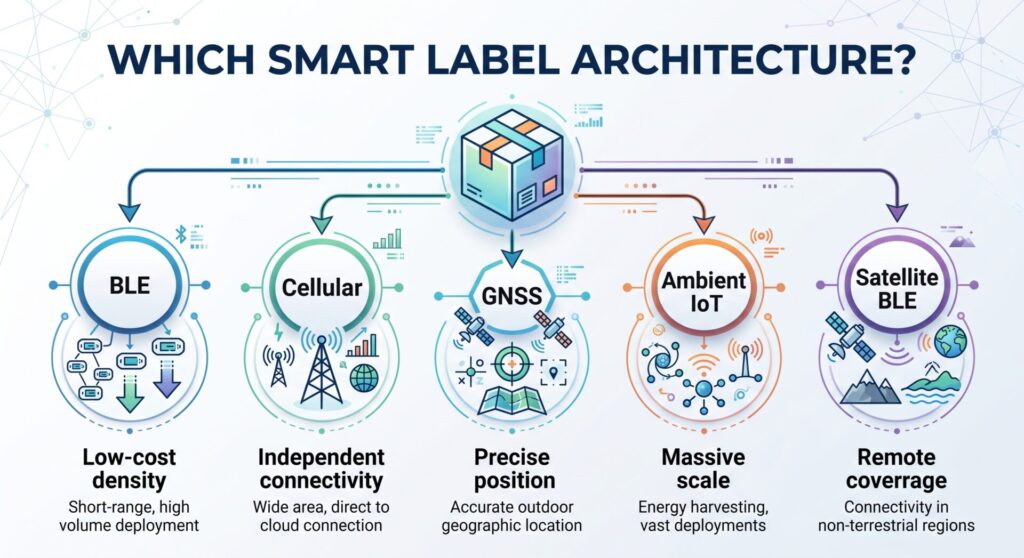
Bluetooth Low Energy (BLE), cellular, GNSS, Ambient IoT, gateways and even satellite-connected Bluetooth can now appear in products that all broadly resemble a thin label.
They do not provide the same type of visibility.
Choosing between them requires understanding the logistics problem first: where the shipment travels, what information you need, how quickly you need it, how much a missed observation matters and what you intend to do when an exception occurs.
Don’t start with the tracker. Start with the problem.
What is the difference between BLE and cellular smart labels?
A BLE smart label broadcasts a short-range radio signal that another device or gateway must detect. A cellular smart label can communicate using mobile-network infrastructure, giving it greater independence from nearby Bluetooth receivers. BLE can offer lower power consumption and potentially lower cost, while cellular generally provides greater autonomy during transportation.
That simple distinction has enormous consequences for shipment visibility.
A BLE label doesn’t inherently have an internet connection merely because it is transmitting.
Something else needs to receive its signal and pass the information onwards.
That receiver might be:
- a dedicated gateway;
- warehouse infrastructure;
- a smartphone;
- vehicle telematics;
- another compatible IoT device.
Reelables, for example, says its labels can emit encrypted signals detected by partner smartphones, access points, IoT infrastructure and vehicle telematics. Its cellular-enabled labels can additionally be located through cellular networks.
That is fundamentally different from a device communicating independently through a cellular network.
Is BLE tracking inferior to cellular tracking?
No. BLE and cellular solve different tracking problems. BLE can be extremely effective where suitable receiving infrastructure exists and very large numbers of low-cost items need visibility. Cellular becomes more attractive when a shipment must communicate independently as it moves through less controlled logistics environments.
This distinction is important because the smart-label market sometimes presents connectivity technologies as though they form a simple hierarchy:
BLE → cellular → GPS = increasingly better tracking.
That’s misleading.
Consider a distribution centre containing 100,000 tagged cases.
Installing appropriate BLE infrastructure and allowing inexpensive labels to report automatically may be much more sensible than putting an independently connected cellular modem into every case.
Now consider a £50,000 piece of equipment travelling across Europe through multiple carriers.
The economics change.
You may care considerably more about maintaining visibility away from controlled infrastructure.
Neither technology is inherently superior.
The use case determines the architecture.
What happens when nobody hears a Bluetooth label?
If a BLE label cannot reach compatible receiving infrastructure, its transmission may not create a cloud location event at that moment. Buyers should therefore evaluate detection coverage along their actual logistics lanes rather than relying solely upon headline network-coverage claims.
This is one of the most important questions in smart-label procurement.
Ask your supplier:
What happens when nobody hears the label?
Then test the answer.
Freight doesn’t remain inside technology-friendly warehouses.
It travels through:
airports, ports, trailers, aircraft, containers, customs compounds, remote roads, cross-docks, third-party warehouses and final-mile vehicles.
Theoretical network size isn’t the same thing as useful detection density along your particular route.
That distinction becomes especially important for cargo security.
A shipment deviating from its intended route is precisely when you may want more visibility.
Unfortunately, abnormal movement can simultaneously take the shipment away from the infrastructure normally responsible for detecting it.
What is changing in Bluetooth tracking in 2026?
Quite a lot.
The assumption that BLE necessarily means short-range warehouse tracking is becoming increasingly outdated.
Hubble Network is particularly interesting. Hubble says existing standard Bluetooth chips can be enabled through firmware to communicate using its terrestrial gateways or satellite network. For logistics, it specifically positions the technology as a way of maintaining shipment connectivity across oceans and locations beyond conventional cellular coverage.
That potentially changes the architecture considerably.
A future tracking label could conceivably use an inexpensive, extremely low-power Bluetooth-class radio while gaining access to:
local BLE infrastructure + terrestrial networks + satellite detection.
That doesn’t eliminate the need to analyse coverage, power and economics.
But it does make the old assumption that “Bluetooth equals local tracking” increasingly questionable.
What is Ambient IoT?
Ambient IoT describes extremely low-power connected devices that can operate using harvested environmental energy or very limited stored energy. The objective is to make connected sensing cheap and power-efficient enough to extend digital visibility to huge numbers of everyday objects.
This is moving beyond marketing terminology.
3GPP has been developing Ambient IoT within Release 19. Its work targets devices with dramatically lower complexity and power consumption than existing NB-IoT and eMTC technologies, including battery-less devices and devices with limited energy storage.
The specifications continue to mature: 3GPP’s Ambient IoT radio specification was already under change control by 2026, while associated device-conformance specifications remained in development.
That matters because smart-label economics could change again.
Today’s debate might be:
£7 BLE label versus £20 cellular label.
Tomorrow’s debate could include massive populations of battery-free or energy-harvesting connected packaging.
Wiliot demonstrates where Ambient IoT is heading
Wiliot provides a useful example.
In January 2026, Wiliot introduced its Gen3 IoT Pixel, a battery-free sensor intended for large-scale retail and supply-chain deployments. Its stated applications include automated receiving, shipment verification, reusable asset tracking and temperature/condition monitoring.
But there is an important architectural lesson here too.
Battery-free doesn’t mean infrastructure-free.
Wiliot explains that its network infrastructure energises nearby Pixels, receives their BLE data and forwards it to the cloud through cellular, Wi-Fi or wired connections. It also states that its Pixels operate as part of an integrated system with its platform rather than independently.
Again, that isn’t a weakness.
It is an architecture.
The question is whether that architecture fits your operation.
What about Reelables?
Reelables is another useful demonstration of why the market can no longer be divided neatly into “Bluetooth labels” and “GPS trackers”.
Reelables now offers Bluetooth and cellular connectivity. In April 2026 it announced Anywhere, marketed as worldwide shipment tracking starting at $8 per label. The company says millions of its labels are now being printed and deployed.
That is significant.
It demonstrates both the falling cost of smart-label tracking and the increasing overlap between technologies.
But an $8 headline price shouldn’t determine your architecture.
The important questions remain:
What connectivity does that particular deployment use?
How frequently is the shipment observed?
How is location determined?
Where might visibility disappear?
How quickly is an exception detected?
What does the complete deployment cost?
And what happens operationally when something goes wrong?
Does a cellular smart label contain GPS?
Not necessarily. Cellular connectivity and GPS/GNSS positioning are separate capabilities. A smart label can use a cellular network for communications while determining location through cellular positioning, Wi-Fi, GNSS or another method. Buyers should ask specifically how position is calculated rather than assuming “cellular tracker” means GPS tracker.
This distinction matters enormously.
Searching for a “disposable GPS tracker” often produces products that provide useful shipment location but don’t necessarily use GNSS for every observation.
GNSS can provide highly useful positioning, but acquiring satellite signals and calculating positions consumes energy.
For a thin device with finite battery capacity, every location event has an energy cost.
That creates another design question:
How much location precision do you actually need?
If knowing that a pallet reached Birmingham at 14:05 solves the business problem, continuously calculating metre-level GNSS coordinates may simply consume battery unnecessarily.
The smart-label architecture decision matrix
| Requirement | BLE | Cellular | Cellular + GNSS | Ambient IoT | BLE + satellite |
|---|---|---|---|---|---|
| Very low device cost | Excellent potential | Moderate | Lower | Excellent potential | Emerging |
| Controlled warehouse | Excellent | Often excessive | Usually excessive | Excellent | Usually unnecessary |
| Cross-border transport | Infrastructure dependent | Strong | Strong | Architecture dependent | Potentially strong |
| Precise outdoor position | Limited by architecture | Variable | Strong | Architecture dependent | Architecture dependent |
| Remote/ocean coverage | Limited conventionally | Limited | Limited by backhaul | Infrastructure dependent | Key potential advantage |
| Battery life | Strong | Moderate | More challenging | Excellent | Potentially strong |
| Massive item-level deployment | Strong | Cost dependent | Less attractive | Excellent | Emerging |
| High-value cargo | Use-case dependent | Strong | Strong | Use-case dependent | Interesting emerging option |
This table isn’t a product ranking.
It is a problem-selection framework.
Why hybrid tracking may ultimately win
The most interesting future may not be BLE versus cellular.
It may be systems that use different location and communication methods according to context.
Imagine a shipment that behaves differently throughout its journey:
Warehouse: BLE provides inexpensive presence detection.
Normal road movement: cellular positioning provides periodic visibility.
High-risk area: reporting frequency increases.
Unexpected movement: GNSS activates to obtain a more precise location.
Remote region: satellite-compatible communications provide another route to the cloud.
Stationary period: the device enters a lower-energy state.
Delivery: reporting reduces or terminates.
Now the competitive advantage isn’t simply the radio inside the label.
It becomes the intelligence deciding when, why and how to use finite tracking resources.
That is where shipment tracking architecture becomes considerably more interesting than device specifications.
How much should a smart label cost?
There is no useful universal target price. Buyers should calculate cost per successfully monitored shipment and business outcome rather than comparing only price per label. Connectivity, software, implementation, integration, support and the value of the information produced all affect the real economics.
An £8 label that solves the problem can be inexpensive.
A £5 label that doesn’t can be very expensive.
Suppose a business buys 100,000 inexpensive BLE labels but subsequently discovers that detection along critical routes isn’t sufficient.
The hardware might perform perfectly according to specification.
The project can still fail.
The reverse can happen too.
A business may deploy cellular/GNSS devices when inexpensive BLE milestone detection would have delivered everything required.
Again, the tracker works.
The architecture was wrong.
How should you choose a smart-label supplier?
Evaluate the organisation implementing the solution as carefully as the hardware. A capable supplier should understand IoT connectivity, logistics operations, device behaviour, integrations and exception management — and should be willing to explain where its technology will not work.
This becomes increasingly important as hardware commoditises.
A professional website is easy to create.
An attractive tracking dashboard is easier to build than it was five years ago.
Neither proves that the organisation behind it has successfully deployed tracking technology.
Ask:
How many real deployments have you completed?
Who manufactures the device?
Who owns and maintains the firmware?
Who operates the platform?
Who provides connectivity?
Who diagnoses missing observations?
Who handles integration failures?
Can you analyse our logistics lanes before recommending hardware?
Can you explain the limitations of BLE, cellular and GNSS?
Can we speak to existing customers?
And perhaps most importantly:
When thousands of our shipments are moving and something stops working, who knows enough to diagnose the problem?
AI-assisted development isn’t inherently a problem.
The issue is technical accountability.
Why your smart-label pilot should be designed to fail
A useful smart-label pilot should expose weaknesses before large-scale deployment. Test real packaging, real carriers, difficult locations, connectivity gaps, battery performance, exception handling and integrations rather than selecting an easy route designed to make the technology look good.
Test:
airport handling;
metal trailers;
international movements;
remote destinations;
warehouse dwell;
poor cellular coverage;
BLE detection gaps;
unexpected route deviations;
temperature exceptions;
different packaging materials;
alert escalation;
API integrations.
Then measure the longest gaps between useful observations.
Don’t simply count successful ones.
The objective isn’t proving that a tracker works.
It is establishing whether the tracking architecture is sufficiently reliable for the business decision you’re trying to make.
What should you measure after deployment?
Avoid making “number of devices deployed” the primary success metric.
Measure outcomes such as:
Cost per successfully monitored shipment
Exception detection time
Reduction in cargo loss
Reduction in temperature excursions
Reduction in claims
OTIF improvement
Reduced dwell time
Reduction in manual scans
Fewer customer-service enquiries
Percentage of journey with useful visibility
Those metrics connect tracking technology to business performance.
Strategic Tracking Verdict
There is no universally best smart-label technology. BLE is compelling for inexpensive, high-volume visibility where detection infrastructure exists; cellular provides greater communications independence; GNSS adds positioning precision at an energy cost; Ambient IoT is opening an entirely new ultra-low-power category; and satellite-enabled BLE could blur today’s connectivity boundaries further. Start with the logistics problem, determine the visibility and intervention requirements, and only then select the architecture.
The smart-label market is moving rapidly.
That is good news for buyers.
Reelables’ expansion into cellular, Wiliot’s battery-free Gen3 architecture, Hubble’s satellite-Bluetooth proposition and 3GPP’s standardisation work all point towards a future with more tracking options, not fewer.
That makes independent technology selection more important.
Don’t ask:
Which tracker is best?
Ask:
What information do we need to make a better operational decision — and what is the least expensive architecture capable of reliably providing it?
That’s where a tracking project should begin.
Frequently Asked Questions
Is BLE or cellular better for shipment tracking?
Neither is universally better. BLE is particularly attractive for high-volume, low-cost tracking where suitable receiving infrastructure exists. Cellular offers greater communications independence and can be preferable for shipments moving through uncontrolled environments.
Can Bluetooth smart labels track shipments internationally?
Yes, if compatible detection infrastructure is available along the journey. Emerging technologies are also expanding BLE’s reach: Hubble, for example, is developing terrestrial and satellite connectivity for standard Bluetooth chips.
Does a cellular smart label have GPS?
Not necessarily. Cellular describes the communications technology. Location may be determined using GNSS/GPS, cellular positioning, Wi-Fi or other methods.
What is Ambient IoT?
Ambient IoT is an emerging class of extremely low-power connected devices that can operate from harvested environmental energy or very limited energy storage. 3GPP is standardising Ambient IoT technology within Release 19.
Are battery-free tracking labels available?
Yes. Wiliot’s Gen3 IoT Pixel is a current example of a battery-free sensor designed for supply-chain and retail applications, although it operates as part of an infrastructure and cloud-platform architecture.
How much do smart tracking labels cost?
Prices vary considerably according to connectivity, sensing, volume and service model. Reelables announced its Anywhere offering in April 2026 with pricing starting at $8 per label, illustrating how rapidly the economics are changing. Buyers should compare complete cost per monitored shipment rather than headline hardware price.
What should I test in a smart-label pilot?
Test actual packaging, actual transport lanes, difficult coverage areas, detection gaps, battery performance, alerts, integrations and exception response. A pilot should deliberately expose weaknesses before a large deployment.
Should every shipment use the same tracker?
Usually not. Shipment value, risk, duration, required location accuracy, sensors and intervention time can justify different tracking technologies within the same organisation.
Is satellite Bluetooth going to replace cellular tracking?
It is too early to conclude that. Satellite-enabled BLE is an important emerging architecture, particularly for remote and ocean coverage, but cellular, terrestrial BLE, GNSS, gateways and Ambient IoT each retain different advantages.
What is the best smart label for logistics?
The best smart label is the least expensive technology that reliably delivers the information required for the particular business problem. Start with the use case rather than a manufacturer.