
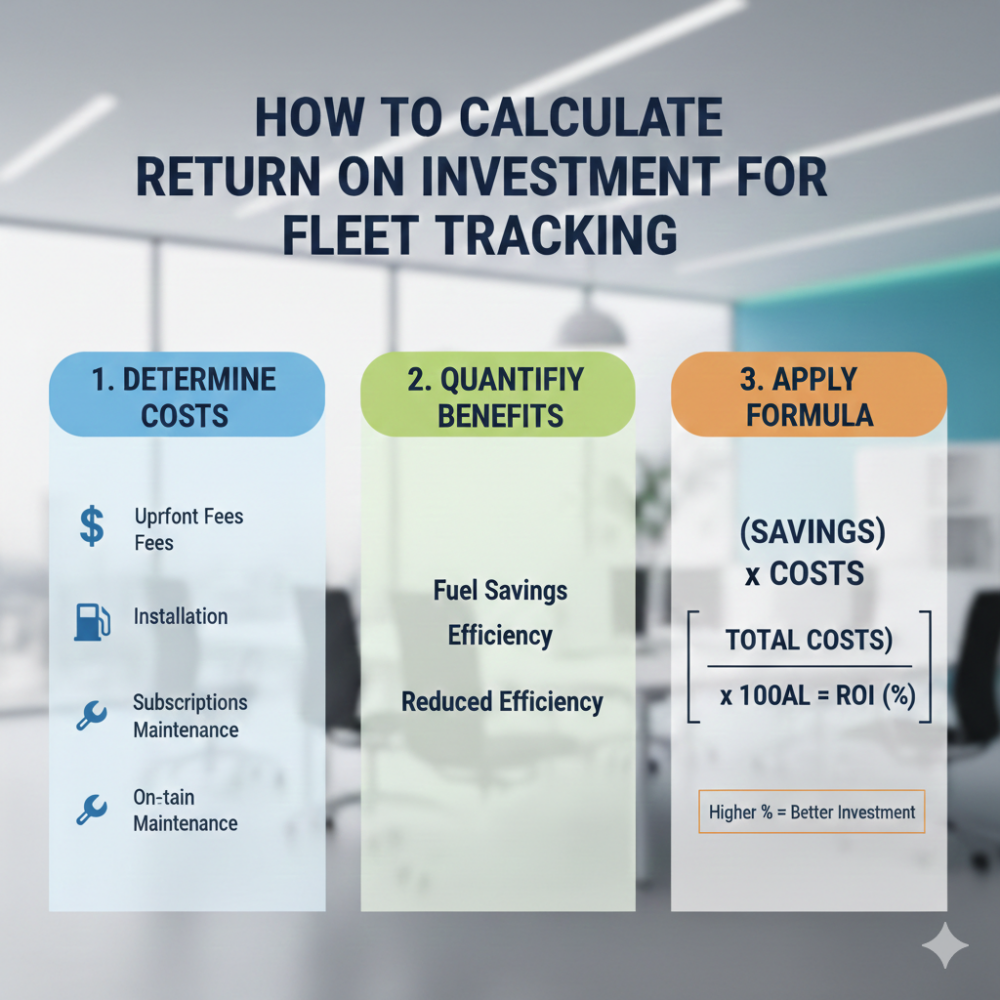
GPS tracking ROI is defined as the financial return from tracking system investments measured against total implementation costs including hardware, subscription fees, and integration expenses. Unlike basic cost analysis, GPS tracking ROI accounts for both direct savings from asset loss prevention and indirect benefits from operational efficiency gains.
What Is GPS Tracking ROI and Why It Matters for Enterprise Buyers
GPS tracking ROI measures the total financial benefit of tracking systems divided by total investment costs multiplied by 100 to express as a percentage. For enterprise buyers, GPS tracking ROI typically ranges from 200% to 500% over three years with payback periods between 4 and 18 months depending on asset loss rates and utilization improvements.
The ROI calculation for GPS tracking includes seven quantifiable benefit categories. Asset loss prevention delivers £50,000 to £250,000 annually for enterprises with 1,000+ tracked assets. Labor savings from reduced search time contribute £15,000 to £75,000 yearly based on warehouse staff hourly rates. Customer satisfaction improvements prevent revenue loss of £100,000+ annually through improved on-time delivery performance.
Best for enterprises managing returnable asset pools, pharmaceutical cold chain operations, high-value shipment logistics, or multi-modal supply chain visibility requirements.
GPS Tracking Investment Components: Hardware, Platform, and Integration Costs
Total GPS tracking investment comprises three primary cost categories. Hardware costs range from £50 to £200 per device for reusable GPS trackers with cellular connectivity, temperature sensors, and rechargeable batteries. Platform subscription fees average £5 to £15 per device monthly for cloud-based tracking dashboards, API access, and alert management systems.
Integration expenses for connecting GPS tracking platforms to ERP systems, TMS platforms, or WMS software cost £5,000 to £25,000 depending on complexity. Training and implementation labor adds £3,000 to £10,000 for initial deployment across multiple facilities or routes. Without proper integration planning, GPS tracking systems fail to deliver ROI despite accurate position data.
Calculate total 3-year investment using this formula: (Hardware Cost × Number of Devices) + (Platform Subscription × 36 months) + Integration + Training + (Device Replacements × 3 years).
Seven Quantifiable GPS Tracking ROI Drivers for Enterprise Logistics
Asset Loss Prevention ROI
Asset loss prevention delivers annual savings calculated as (Current Loss Rate – Future Loss Rate) × Asset Value × Number of Assets. For example, 1,000 returnable pallets valued at £50 each with 15% annual loss rate costs £7,500 yearly. GPS tracking reduces loss rate to 4% annually saving £5,500 per year. Best for automotive pallet pools, beverage keg tracking, pharmaceutical container management, and retail returnable asset programs.
Utilization Improvement ROI
Utilization improvement ROI measures avoided asset purchases from faster cycle times. Current 45-day pallet cycles reduced to 30 days through GPS tracking improves turns by 33%. A 1,000-pallet fleet avoiding 500 new pallet purchases saves £25,000 capital expenditure plus £5,000 annually in reduced storage costs. Without GPS visibility, enterprises overpurchase assets to compensate for poor utilization rates.
Labor Savings from Reduced Search Time
Labor savings ROI equals (Hours Saved Weekly × Hourly Rate × 52 weeks). Five warehouse staff spending 4 hours weekly searching for assets at £18 hourly rate costs £18,720 annually. GPS tracking reducing search time by 80% delivers £14,976 yearly savings. Best for distribution centers with frequent asset movements, cross-docking operations, and multi-site logistics networks.
Customer Satisfaction and Retention Benefits
Customer satisfaction ROI includes reduced chargebacks plus retained revenue from improved service levels. On-time-in-full (OTIF) improvements from 87% to 96% reduce customer penalties by £15,000 annually. Preventing loss of one £100,000 annual revenue customer delivers total benefit of £115,000 yearly. Unlike asset loss prevention with hard numbers, customer retention requires conservative estimation.
Compliance Cost Avoidance for GDP and DSCSA
Compliance ROI measures avoided GDP violations, investigation costs, and product recall risk. Pharmaceutical logistics reducing GDP violations from 12 to 2 annually at £5,000 per violation saves £50,000 yearly. Temperature excursion monitoring reducing product recall probability from 5% to 0.5% delivers £22,500 risk mitigation value. Best for pharmaceutical cold chain, clinical trial logistics, and food safety compliance operations.
Insurance Premium Reduction
Insurance premium reduction ROI ranges from 10% to 15% of annual cargo insurance costs when GPS tracking is implemented. A £50,000 annual premium with 12% GPS tracking discount saves £6,000 yearly. Without carrier documentation of tracking systems, insurance discounts are unavailable regardless of loss prevention benefits.
Operational Efficiency and Process Improvement
Operational efficiency ROI equals (Time Saved per Shipment × Monthly Shipments × Hourly Rate × 12 months). Automated exception alerts reducing manual investigation from 15 to 5 minutes per shipment saves 10 minutes across 500 monthly exceptions. This delivers 1,000 hours annually valued at £25,000 for logistics coordinator roles at £25 hourly rates.
GPS Tracking ROI Calculation Formula with Pharmaceutical Example
GPS tracking ROI calculation follows this formula: ROI % = ((Annual Benefits – Ongoing Costs) × Years – Total Investment) / Total Investment × 100. Payback period in months equals Total Investment / (Annual Benefits / 12).
Pharmaceutical cold chain example: 50 GPS trackers with temperature sensors cost £7,500 hardware plus £15,000 three-year platform subscription plus £8,000 integration equals £39,500 total investment. Annual benefits include £45,000 GDP compliance savings, £22,500 recall risk mitigation, £12,000 labor savings, £8,000 chargeback reduction, and £4,500 insurance premium reduction totaling £92,000 yearly.
Year 1 ROI equals ((£92,000 – £39,500) / £39,500) × 100 = 133%. Three-year ROI equals ((£92,000 × 3 – £8,750 × 2) – £39,500) / £39,500 × 100 = 554%. Payback period equals £39,500 / (£92,000 / 12) = 5.2 months.
Common GPS Tracking ROI Objections and Data-Driven Responses
CFO objection: ‘ROI looks too good to be true.’ Response: Conservative estimates based on verifiable baseline data show current 15% asset loss rate documented in warehouse reports over 12 months. Expected 4% reduction comes from three customer references with similar use cases. Sensitivity analysis demonstrates 180% ROI with 8-month payback even if benefits are 30% lower than projected.
CFO objection: ‘Can we use a cheaper solution?’ Response: Budget GPS tracking options lack GDP compliance certification creating regulatory risk. Mid-price recommended solutions meet all pharmaceutical requirements with strong customer references. Premium options cost £40,000 more but deliver features beyond enterprise requirements. Unlike cheaper alternatives without temperature monitoring, compliant systems prevent costly recall events.
CFO objection: ‘Why implement now versus deferring 6-12 months?’ Response: Cost of delay equals £125,000 for 6-month deferral on £250,000 annual asset losses. New GDP regulations effective April 2026 make temperature tracking mandatory. Two competitors already use GPS tracking for service differentiation winning business on delivery performance. Without immediate implementation, regulatory risk and competitive disadvantage increase quarterly.
GPS Tracking ROI Measurement: Key Performance Indicators and Baseline Metrics
GPS tracking ROI measurement requires baseline metrics captured before implementation and ongoing KPI monitoring post-deployment. Baseline asset loss rate documentation over 12 months establishes current state for loss prevention ROI calculations. Labor hour tracking for asset search activities quantifies pre-implementation inefficiency costs.
Post-implementation KPIs include device uptime percentage targeting 95%+, position accuracy within 10 meters for 90% of readings, and operator compliance above 95% for proper device attachment. Business outcome KPIs measure asset loss rate reduction targeting 60%+ improvement, search time reduction of 70%+, and OTIF percentage increases of 5-10 percentage points.
Monthly ROI review meetings compare actual benefits versus projected benefits across all seven ROI categories. Without systematic measurement, GPS tracking ROI claims remain unverifiable preventing budget expansion or renewal approvals.
Strategic Tracking: Independent GPS Tracking ROI Consulting and Vendor Selection
Strategic Tracking provides vendor-agnostic GPS tracking ROI analysis for enterprise buyers across pharmaceutical logistics, returnable asset management, cold chain operations, and supply chain visibility applications. With 20+ years tracking industry expertise and relationships with 150+ verified solution providers, Strategic Tracking helps enterprises calculate accurate ROI projections, identify appropriate technology solutions, and make warm introductions to pre-vetted GPS tracking vendors.
Unlike GPS tracking vendors with inherent sales bias, Strategic Tracking’s consultative approach matches solution complexity and pricing to buyer requirements while avoiding vendor conflicts through category segmentation. For GPS tracking ROI consulting services, contact us or visit strategictracking.com to access comprehensive solution directories and ROI calculation tools.