
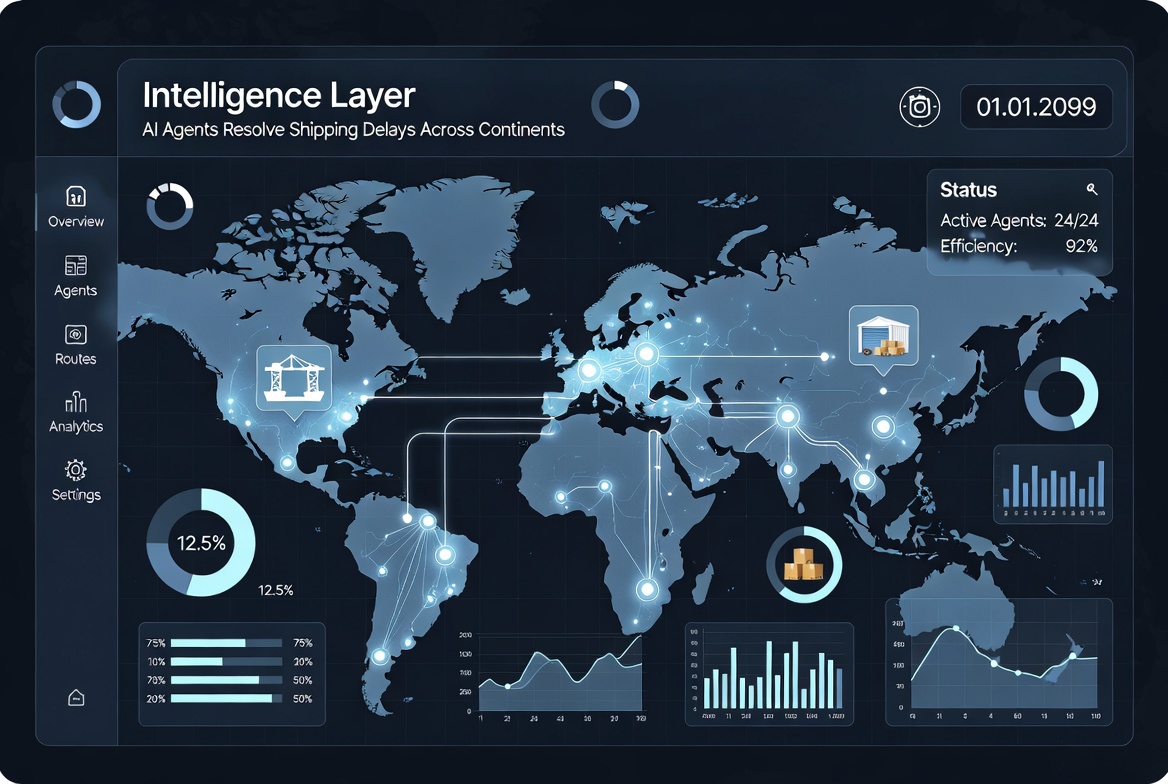
The Era of the Self-Healing Supply Chain
As we move past the mid-February mark, the “Visibility Gap” is being closed not by more data, but by better execution. The industry is shifting from “What happened?” to “What is my AI agent doing about it right now?”
1. Agentic AI Control Towers: From “Alerting” to “Acting”
As of Q1 2026, the traditional Supply Chain Control Tower is being replaced by Agentic AI Intelligence Layers. Leading firms are no longer satisfied with dashboards that merely surface delays; they are deploying multi-agent systems that autonomously resolve them.
Unlike legacy automation, Agentic AI uses reinforcement learning to simulate thousands of “what-if” scenarios in seconds. When a port congestion signal is detected via real-time IoT feeds, the agent doesn’t just send an email—it evaluates alternative capacity, checks contract compliance, and initiates a re-booking request via API. This “Decision Velocity” compresses response times from days to minutes.
“In 2026, AI in the supply chain will move from proof‑of‑concept experiments to embedded, agentic capabilities… identify risks, propose workarounds, and even trigger corrective actions automatically.” — Richard Howells, SAP Supply Chain Management (Feb 2026).
Visibility without an execution layer is just a more expensive way to watch your shipments fail. If your 2026 roadmap doesn’t include Agentic Orchestration, you aren’t managing a supply chain; you’re managing a news feed.
2. GS1 TDS 2.3: RFID Pallets That “Phone Home”
The release of GS1’s RFID Tag Data Standard (TDS) 2.3 has officially made supply chain data “Web-Native.” Pallets and logistics units can now carry web-resolvable domain names directly within the EPC memory of the RFID tag.
By embedding a Digital Link (URL) in the tag, a simple scan now resolves directly to an authoritative data source. This eliminates the need for brittle, proprietary lookup tables between 3PLs and shippers. When law enforcement or an intermediary scans a recovered pallet, the tag “phones home” to verify provenance, source certifications, and real-time status, drastically lowering the friction for theft recovery and customs clearance.
The RFID tag is no longer a silent ID; it is a discoverable web service. Transitioning to TDS 2.3 is the fastest way to harden your chain of custody against organised cargo crime.“This new capability is a powerful tool in the fight against supply chain theft… it lowers the friction for law enforcement to press charges and for retailers to reclaim their property.” — Jonathan Gregory, Senior Director, GS1 US
New! Tracking Tech - Planning, Implementation & Best Practices for 2026
Based on 20+ years experience of implementing 100s of GPS tracking projects, we have written this easy-to-read best practice guide and checklist to help you plan and implement GPS tracking and realtime visibility solutions. Download Your Free 2026 Guide Here
3. The “Security Handshake”: Cyber-Physical Vault Convergence
High-value cargo security in 2026 has transitioned to the “Chain of Identity” model. Modern “Smart Vaults” and high-security containers are now integrated with real-time transit telemetry to prevent the “Strategic Identity Theft” surging across load boards.
This hybrid security model uses geofenced biometric triggers. The container or trailer vault remains in a “Hardened State” and cannot be opened unless three variables align: the truck’s GPS matches the delivery geofence, the driver’s biometric digital ID is verified via the carrier’s secure portal, and a one-time “Security Handshake” token is exchanged with the receiver’s dock system.
Digital identity is the new physical lock. By 2026, high-value shippers must treat Cyber-Physical integration as a baseline requirement. If your cargo monitoring doesn’t control the physical access point, you are leaving the door open to AI-driven impersonation fraud.
💡Idea for the Future: “The Verifiable Ghost”
The Concept: A temporary, AI-generated “Ghost Digital Identity” for high-value loads.
How it Works: To combat cargo reconnaissance, the shipment’s real data (value, contents, destination) is encrypted into a “Ghost Identity” that only reveals its true nature to authorized sensors at 100-mile intervals. To any unauthorized scanner or load-board hacker, the pallet appears as low-value, non-descript commodities.
The Strategic Why: We win the “Information War” by making high-value cargo invisible to the digital reconnaissance tools used by modern crime syndicates.
📅 Industry Calendar: Upcoming Events
-
Truckload 2026 (TCA Annual Convention) | Feb 28 – March 3 | Orlando, FL | Must-attend for securing the identity layer of the carrier network.
-
Global Cold Chain Institute (West) | March 1–4 | Tempe, AZ | Crucial for navigating FSMA 204 “Shadow Enforcement.”
-
TPM26 (Trans-Pacific Maritime) | March 1–4 | Long Beach, CA | The benchmark for Agentic AI integration in ocean contracts.