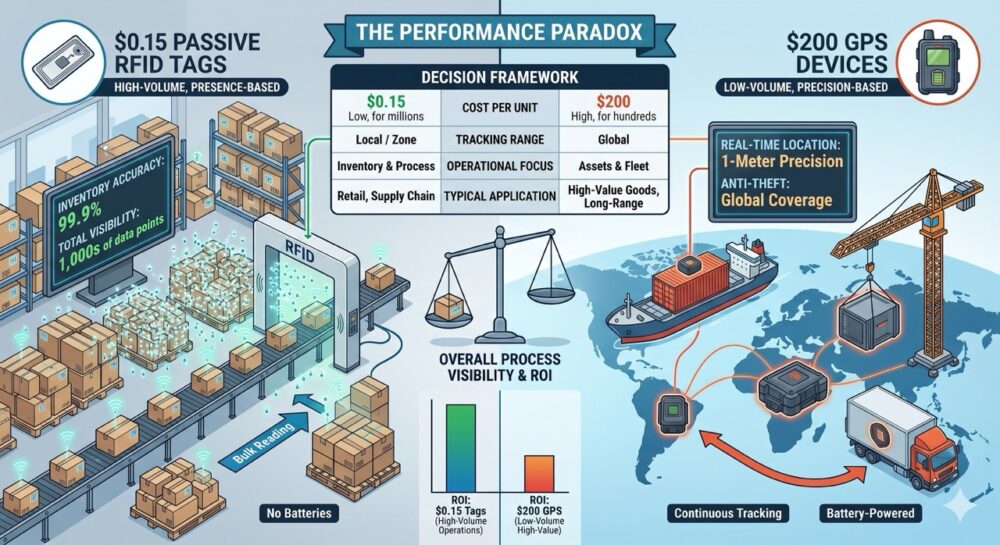
Asset tracking technology selection between RFID and GPS determines whether enterprises spend £100,000 or £2M tracking identical asset populations. GPS trackers costing £150-400 per device provide global outdoor positioning but fail indoors and require weekly charging unsuitable for 10,000+ asset deployments. Passive RFID tags at £0.15-0.40 each scale economically across massive populations operating battery-free for 10+ years but provide checkpoint visibility only, not continuous real-time location. This comparison framework reveals when low-cost RFID delivers superior operational value versus scenarios demanding GPS despite 1,000x higher per-asset cost.
What fundamental capability differences separate RFID from GPS tracking?
GPS determines absolute geographic position through satellite triangulation enabling outdoor location accuracy 5-10 meters anywhere on Earth. Devices continuously compute coordinates consuming 50-200mW power requiring battery charging every 3-7 days for real-time tracking or 2-5 years with daily position updates. This technology excels at fleet vehicles, construction equipment, and international cargo requiring route visibility and theft recovery across unlimited geographic range.
RFID operates through electromagnetic coupling between reader and tag providing relative position (detected by which reader) not absolute coordinates. Passive UHF RFID tags harvesting energy from reader signals operate indefinitely without batteries or maintenance at 3-8 meter read range through doorway portals. Active RFID incorporating batteries extends range to 30-100 meters for real-time location within buildings but costs £25-60 per tag versus £0.15-0.40 passive, limiting economic viability to smaller high-value populations.
The indoor/outdoor operational environment determines technology viability more than any other factor. GPS requires clear sky visibility losing signal inside buildings, underground facilities, dense urban canyons, or enclosed transport creating 30-minute to 8-hour blind spots during warehouse handling or indoor production. RFID functions reliably indoors regardless of building construction but provides no outdoor visibility beyond reader-equipped doorways or vehicle loading areas.
When does passive RFID deliver better ROI than GPS despite lacking real-time position?
Decision Factor | Choose RFID When… | Choose GPS When… |
Asset Value | <£100 per item (tag cost <1% asset value) | >£2,000 per item (justifies tracker investment) |
Population Size | >50,000 items (RFID scales better) | <5,000 items (GPS manageable) |
Environment | 80%+ indoor operations | 80%+ outdoor operations |
Update Frequency | Checkpoint verification sufficient | Continuous real-time position required |
Battery Maintenance | Zero tolerance (no charging infrastructure) | Acceptable (dedicated charging staff available) |
Geographic Range | Limited locations (depots, facilities) | Unlimited range (cross-country, international) |
Theft Recovery | Low priority (insurance acceptable loss) | Critical (£50k-£500k asset value each) |
Retail grocery tote tracking exemplifies RFID dominance despite lacking GPS capabilities. Supermarket chains managing 500,000-3M plastic totes worth £8-15 each cannot economically deploy £200 GPS trackers exceeding container value. Passive RFID at £0.15-0.40 per tag embedded during tote manufacturing scales across massive populations. Portal readers at distribution centers and supplier receiving docks automatically log checkpoint passages providing supply chain visibility sufficient for detention billing and loss prevention without continuous position monitoring GPS provides.
Manufacturing work-in-progress tracking demonstrates RFID checkpoint model effectiveness. Automotive assembly plants tracking 50,000-200,000 component bins through 50-100 process stations deploy RFID portals at each workstation reading tags as bins arrive and depart. This checkpoint data feeds MES (Manufacturing Execution Systems) triggering next-step workflows without requiring continuous GPS position updates consuming battery power and cellular data charges. Total RFID investment of £300,000-£800,000 across 100-station facility costs 60-75% less than equivalent GPS deployment.
VENDOR SELECTION CRITERIA
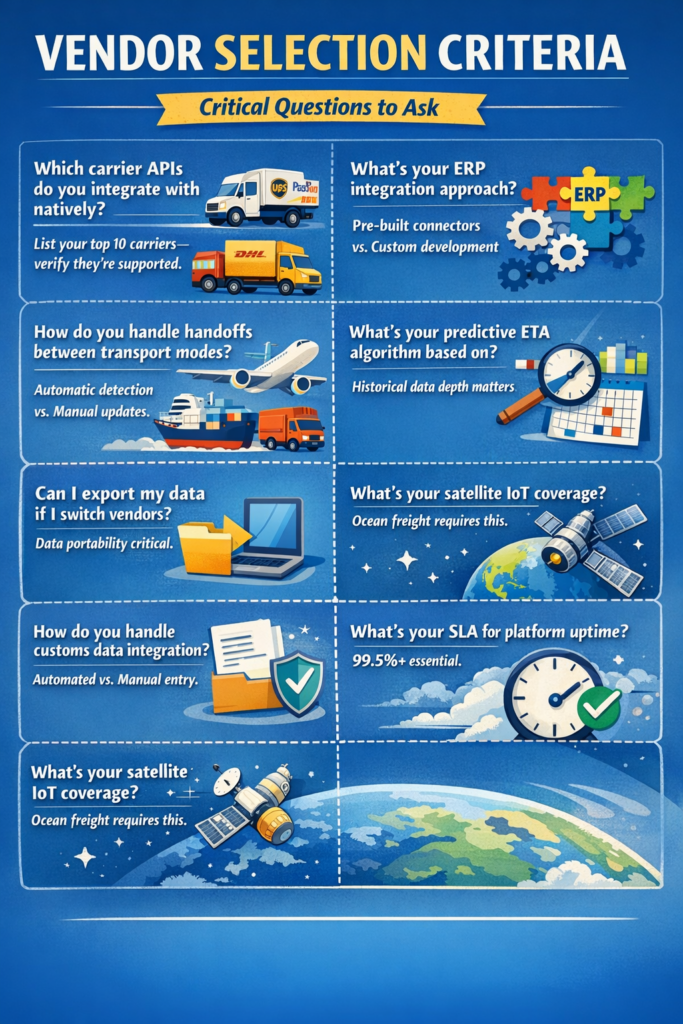
Find out more about selecting vendors in our new 2026 guide to visibility platforms.
Based on 20+ years experience of implementing 100s of GPS tracking projects, and IOT temperature monitoring systems we have written this easy-to-read best practice guide and checklist to help you plan and implement GPS tracking and realtime visibility solutions.
Download Your Free 2026 Guide Here
When does GPS justify 1,000x higher cost versus passive RFID?
Construction equipment theft prevention requires unlimited geographic range RFID cannot provide. Excavators, compressors, and generators worth £15,000-£300,000 each operate across 50-200 km radius moving between job sites, storage yards, and maintenance facilities. GPS tracking enabling theft recovery within 24-72 hours through police coordination justifies £150-350 per-asset investment preventing £8M-£25M annual loss rates typical without tracking. RFID portal-based detection provides insufficient coverage across dispersed construction sites and public roads where stolen equipment travels.
International shipping containers demand GPS visibility across 30-60 day ocean transit where RFID infrastructure is nonexistent. Cargo valued £100,000-£2M per container requires continuous position monitoring enabling customs clearance preparation, demurrage dispute resolution, and temperature excursion investigation. Unlike domestic logistics operating within controlled facility networks where RFID portals exist, international freight traverses 50-150 entities (ports, rail yards, customs facilities, distribution centers) preventing RFID reader standardization. GPS with satellite IoT backup provides only universal technology operating across fragmented global supply chain.
Fleet vehicle management requires route optimization and real-time dispatch impossible with checkpoint RFID. Logistics companies operating 100-500 delivery vehicles optimize routes dynamically based on traffic conditions, customer delivery windows, and vehicle location. GPS updating position every 1-5 minutes enables dispatchers reassigning deliveries to nearest available vehicle reducing daily mileage 8-15% versus static route planning. RFID providing location only when vehicles pass depot gates offers insufficient visibility for operational optimization generating £60,000-£180,000 annual fuel savings per 100-vehicle fleet justifying £150-400 per-vehicle GPS investment.
How do hybrid RFID + GPS solutions address multi-environment tracking?
Returnable transport equipment cycling between outdoor transit and indoor facilities justifies dual-mode tracking. Automotive manufacturers tracking 20,000-50,000 pallets and bins worth £250-800 each deploy RFID tags for checkpoint verification at supplier receiving docks combined with GPS trackers on 5-10% highest-value containers requiring theft recovery capability. This hierarchical approach costs £150,000-£350,000 (RFID on all containers plus GPS subset) versus £4M-£8M tagging everything with GPS, while maintaining outdoor visibility for premium assets most prone to theft or loss.
Pharmaceutical cold chain implements RFID for depot inventory control with GPS for outdoor transportation monitoring. Distribution networks tracking 10,000-50,000 temperature-controlled totes use passive RFID at warehouse checkpoints verifying receipt and dispatch while single-use GPS+temperature data loggers monitor individual high-value shipments (£50,000-£500,000 biologic cargo) during outdoor transit. This combination provides continuous temperature visibility during transportation risk periods while avoiding GPS costs on every tote cycling through controlled depot environments where RFID portal scanning suffices.
Rental equipment operations optimize utilization through GPS outdoor positioning plus RFID yard inventory management. Construction equipment rental companies tracking 500-2,000 machines use GPS monitoring location and usage hours during customer rental periods enabling accurate billing and theft prevention. Between rentals, RFID readers at yard gates automatically log equipment returns and checkouts providing inventory control without requiring continuous GPS cellular data charges (£5-15/month per device) during non-revenue periods when machines sit idle in storage yards.
What total cost of ownership differences determine technology selection?
Five-year TCO analysis reveals RFID economic advantage for high-volume populations despite higher infrastructure investment. Consider 50,000-asset deployment comparing passive RFID versus GPS tracking:
Cost Component | Passive RFID (50k assets) | GPS Tracking (50k assets) |
Tags/Devices | £15,000 (£0.30 each) | £10M (£200 each) |
Infrastructure | £400,000 (portals/readers) | £150,000 (platform/software) |
Annual Data/Cellular | £0 (no connectivity needed) | £450,000 (£9/device/month) |
Battery Replacement | £0 (battery-free passive tags) | £3M (£60/device every 3 years) |
5-Year Total Cost | £415,000 | £15.4M |
This 37x cost difference (£415k RFID vs £15.4M GPS) explains why high-volume indoor applications overwhelmingly select RFID despite lacking continuous position visibility. The ROI calculation shifts dramatically for outdoor high-value asset populations: 500-vehicle fleet GPS investment of £100,000-£200,000 generates £215,000-£400,000 annual operational savings through fuel optimization and labor reduction, while RFID providing no outdoor visibility delivers zero value despite lower technology cost.
What common technology selection mistakes result in stranded investments?
GPS deployment for predominantly indoor operations represents most frequent failure. Warehouses installing GPS trackers on 5,000-10,000 forklifts and pallet jacks discover tracking goes dark 70-80% of time during indoor operations when equipment enters buildings losing satellite signal. This mistake costs £1M-£2M across 5,000-asset deployment requiring complete replacement with BLE indoor positioning or RFID portal systems. Prevention requires honest assessment documenting actual indoor versus outdoor operational time before vendor selection.
RFID selection for unlimited geographic range applications fails to provide visibility during critical theft risk periods. Construction equipment companies implementing RFID portals at 20-30 storage yards discover stolen equipment never returns through monitored gates, rendering detection useless for theft prevention primary business case. This misalignment creates £200,000-£600,000 stranded infrastructure investment requiring GPS overlay or abandonment. Success requires defining whether checkpoint verification or continuous outdoor positioning drives operational value before technology commitment.
Battery maintenance underestimation creates operational failures post-deployment. Organizations deploying 10,000+ GPS trackers without dedicated charging infrastructure discover battery management consuming 200-400 hours monthly at £20/hour labor cost (£48,000-£96,000 annually). This unexpected overhead undermines business case ROI requiring hiring dedicated battery management staff or switching to passive RFID eliminating charging requirements. Preventing this failure requires realistic assessment whether charging infrastructure and labor exist before GPS selection.
Technology selection decision framework: RFID vs GPS
- Step 1: Document indoor vs outdoor operational time split across asset lifecycle
- Step 2: Calculate total population size and per-asset value determining tag/device cost viability
- Step 3: Define whether checkpoint verification or continuous position drives business value
- Step 4: Assess battery charging infrastructure availability and maintenance labor capacity
- Step 5: Evaluate geographic range requirements (facility-constrained vs unlimited)
- Step 6: Consider hybrid approach using RFID baseline with GPS overlay on high-value subset
- Step 7: Model 5-year TCO including tags/devices, infrastructure, connectivity, and battery replacement
- Step 8: Pilot both technologies on 50-200 representative assets validating assumptions before full deployment
This systematic evaluation prevents £200,000-£2M stranded technology investments from wrong selection between RFID and GPS. The optimal choice depends on specific operational requirements rather than technology superiority claims. Organizations succeeding with tracking implementations match technology capabilities to actual business needs through honest assessment of operational environment, asset characteristics, and value-driving use cases before vendor engagement.
Strategic Tracking provides vendor-agnostic technology selection consulting across GPS, RFID, BLE, UWB, and hybrid solutions. Our assessment methodology evaluates operational requirements, infrastructure readiness, and total cost of ownership recommending optimal technology combinations rather than single-vendor solutions. We manage parallel pilot programs validating technology performance before full-scale deployment preventing stranded investments from wrong technology selection.