
Deep Reefer Telematics, Agentic Realities, and the $47B Smart Interface
Welcome to Tracking Tuesday.
The mid-July 2026 data cycle brings a dramatic structural realization: passivity is an operational liability.
Following Gartner’s formal release of the defining technology trends for the year, the industry has fundamentally broken away from passive human-monitored dashboards. Leading logistics networks are moving rapidly toward systems that are intelligent, self-directed, and legally accountable. This week, we analyze the convergence of mass-scaled maritime reefer IoT, Gartner’s agentic mandate, and the explosive macro trajectory pushing smart labels into a multi-billion dollar protective shield.
Here is the breakdown of the major tectonic shifts hitting the wires:
👉 Maersk’s Reefer IoT Mass Rollout: Maersk has initiated the deployment of its next-generation reefer IoT nodes across 30% of its global refrigerated container fleet. Shippers can now demand active, edge-computed environmental monitoring that dynamically adjusts internal cooling systems at sea without waiting for manual terminal downloads.
👉 Gartner’s 2026 Technology Mandate: Gartner has officially crowned Agentic AI and Physical AI as the defining trends of 2026. The message to CSCOs is clear: visibility is no longer about human dashboards. Your IoT telemetry must be structured to feed virtual AI workforces capable of executing reroutes and resolving exceptions autonomously.
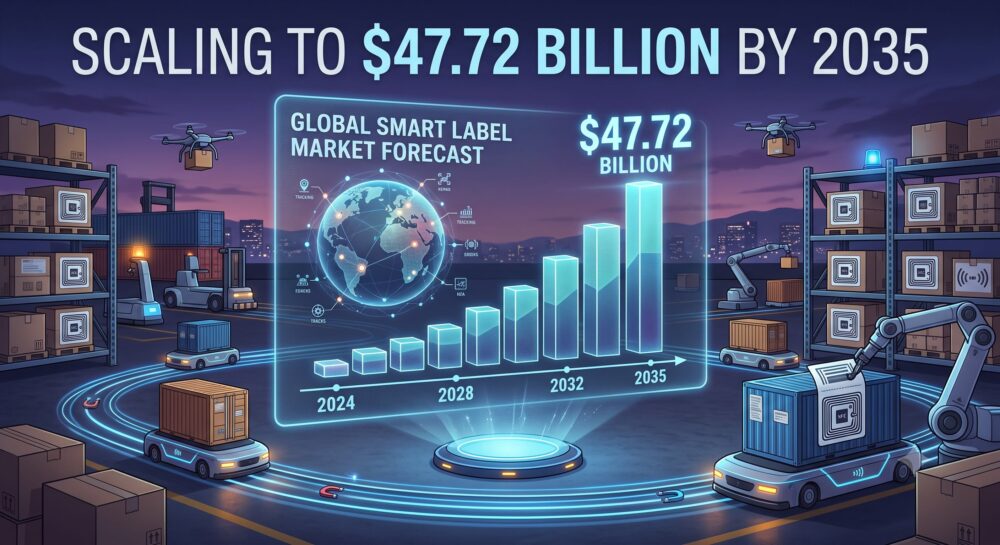
👉 The Smart Label Explosion (+11.32% CAGR): Fresh data projects the global smart label market to scale to a massive $47.72 billion by 2035. Driven by strict EU Digital Product Passport (DPP) compliance laws and luxury/pharma anti-counterfeiting needs, paper-thin flexible stickers are graduating into immutable cryptographic shields.
1. Maritime Autonomy: Maersk Deploys Next-Gen Reefer IoT Connectivity Across 30% of Fleet
Following an intensive closed-beta validation phase, global maritime leader A.P. Moller – Maersk formally executed the mass commercial roll-out of its next-generation refrigerated container (reefer) IoT connectivity modules on July 13, 2026, successfully retrofitting 30% of its active global cold chain infrastructure.
Conventional ocean cold chain monitoring has historically suffered from high latency, leaving cargo teams blind to mid-ocean ambient spikes until the vessel docks and the damage is done. Maersk’s upgraded architecture embeds high-frequency, low-power cellular and satellite edge nodes directly into the reefer’s central controller. Rather than merely logging data passively, these edge processors execute continuous localized analysis of internal temperature, humidity, and atmospheric gas coefficients—dynamically adjusting internal cooling metrics on the fly while streaming sub-minute status updates back to global cloud networks.
“Cold chain transparency cannot be a retrospective autopsy. Real-time condition logging must actively protect the asset while at sea to satisfy strict pharmaceutical and carbon provenance mandates.” — Maritime Logistics Telematics Review, July 2026.
If your intermodal carriers are still providing post-delivery temperature downloads to verify compliance, your cold chain architecture is obsolete. Shippers handling high-value biopharmaceuticals or climate-sensitive agricultural lines must mandate automated, active edge-condition modification to mitigate risk before cargo reaches the terminal.
2. The Gartner 2026 Mandate: The Shift to Physical and Agentic AI
On June 30, 2026 (with deeper implementation analyses landing across global supply networks this week), global research firm Gartner, Inc. officially published its Top Supply Chain Technology Trends for 2026, naming Physical AI and Agentic AI as the core strategic imperatives for Chief Supply Chain Officers (CSCOs).
Gartner’s 2026 framework signals a clean break from experimental pilots to Autonomous Operational Execution. Physical AI bridges the physical-digital gap by embedding advanced machine learning models directly into edge IoT sensors, robotics, and container systems to enable real-time sensing, analysis, and safety configurations on the fly. Simultaneously, Agentic AI introduces a virtual workforce of coordinated digital agents capable of proactively planning, acting, and adapting to disruptions in complex transportation corridors—moving completely beyond human dashboards to execute automated re-routing and capacity allocation.
“This year’s trends highlight the growing role of AI as the foundation for more autonomous, intelligent and adaptive supply chains… These shifts represent more than incremental improvements. They are catalysts for transforming supply chains.” — Christian Titze, VP Analyst and Chief of Research, Gartner.
If your visibility investments still terminate at a dashboard meant for a human coordinator to watch, you are building an operational bottleneck. 2026 competitiveness requires Agentic-Ready Data—clean, low-latency, and highly structured telemetry streams that allow automated agents to make high-quality, auditable decisions on your company’s behalf without waiting for manual authorization.
New! Tracking Tech - Planning, Implementation & Best Practices for 2026
Based on 20+ years experience of implementing 100s of GPS tracking projects, we have written this easy-to-read best practice guide and checklist to help you plan and implement GPS tracking and realtime visibility solutions. Download Your Free 2026 Guide Here
The Smart Label Inflection: Market Projecting to Hit $47.7B by 2035
A comprehensive multi-market sector index published on July 12, 2026, revealed a massive acceleration in digital packaging expenditures, forecasting that the global Smart Labels Market will scale to a staggering $47.72 billion by 2035, compounding at an 11.32% CAGR.
The primary catalyst for this massive capital wave is the intersection of strict regulatory mandates—such as the EU Ecodesign for Sustainable Products Regulation (ESPR) and the GS1 Digital Link standard—with the extreme miniaturization of wide-area communication modules. Smart labels are graduating from passive tracking stickers to Cryptographic Brand Shields. The market expansion is heavily dominated by advanced RFID, NFC, and printed sensor layers designed to combat product counterfeiting, verify material authenticity, and establish seamless end-to-end product provenance across luxury retail and pharmaceutical chains.
The Item is the Ledger. Shippers can no longer treat item packaging as a simple structural box. At a near-12% growth trajectory, digital product passports (DPPs) embedded directly into paper-thin smart labels are becoming an industry standard. Shippers must align their serialization pipelines with cloud knowledge graphs today to ensure every single retail unit can independently verify its own journey and regulatory status upon a simple consumer scan.
Supplier Quick Quotation Request
🌌 IDEA FOR THE FUTURE: THE “DIAGNOSTIC THERMAL LEAP” CONTEXT
The Concept: A completely self-directed, parametric cold chain envelope that leverages next-gen reefer IoT and agentic logic to legally and physically defend its own integrity.
How it Works: By embedding a Samsara-styled single-use BLE asset label inside individual pharma boxes loaded into a Maersk Next-Gen IoT Reefer, the freight constructs its own decentralized security mesh. Utilizing a Gartner-defined Physical AI node, the container continuously analyzes its own internal thermal environment.
If a refrigeration malfunction occurs at sea, the reefer’s edge controller doesn’t just log an error message. It initiates an Agentic AI workflow via satellite that queries global trade ledgers, secures emergency cold-storage customs clearance at the nearest alternate port, and executes an automated insurance adjustment—instantly pushing cryptographically signed forensic proof of condition directly to the cargo underwriters before the vessel ever hits the dock.
The Strategic Why: It eliminates human delay and cargo loss concealment. The freight becomes an independent financial and operational actor, managing its own rescue and liability loop in real time.
📅 INDUSTRY EVENTS
-
International Conference on Multimodal Transportation and Logistics (ICMTL)
-
Date: July 14–15, 2026 (Starts Today!) | Location: London, UK / Hybrid
-
Strategic Focus: The premier mid-July meeting opens today, explicitly focusing on validating multi-modal data integrity across international maritime, rail, and over-the-road freight interfaces.
-
-
ACT-IAC Emerging Technology & Supply Chain Innovation Forum
-
Date: July 21, 2026 | Location: Global/Virtual
-
Strategic Focus: Analyzing how low-cost disposable smart labels, advanced edge computing, and cryptographically signed telemetry data align with federal procurement and asset custody frameworks.
-
-
CSCMP Edge 2026 (Annual Supply Chain Conference)
-
Date: September 20–23, 2026 | Location: Nashville, TN
-
Strategic Focus: Staging the enterprise transition from manual dashboards to agentic multi-agent systems (MAS) to mitigate macro inflation and cross-border lane disruptions.
-