Automotive just-in-time (JIT) manufacturing requires 99.5%+ on-time delivery with 30-minute arrival windows making supply chain visibility critical for preventing production line stoppages costing £50,000-£150,000 per hour. Jaguar Land Rover, BMW, Mercedes-Benz, and Audi operate single-shift production schedules with 90-120 minutes inventory buffers for critical components meaning late supplier deliveries trigger immediate line stoppages halting thousands of vehicles. GPS tracking on returnable pallets and specialty containers enables real-time visibility across Tier 1 supplier networks preventing detention at competing OEMs and enabling automatic rerouting when traffic delays approach 15-20 minute thresholds triggering alternative supplier activation.
What a genuine multimodal solution needs to do
Production line economics force extreme inventory minimization. Modern automotive plants produce 1,500-3,500 vehicles daily consuming 8,000-15,000 component SKUs arriving throughout daily production schedule. Every part consuming warehouse space costs £0.50-2.50 per unit daily in storage, handling, and management overhead across multi-month inventory holds. A single delivery late by 30 minutes delaying 600 vehicles at £25,000 average wholesale value represents £15M production output disruption justifying £250,000 daily supplier service fees ensuring on-time arrival.
Component complexity prevents advance substitution. Engine blocks, transmission housings, and electrical harnesses for specific vehicle configurations arrive in precise sequence scheduled to production line timing. Unlike consumer goods manufacturing substituting products when upstream suppliers delay, automotive cannot interchange components between model versions (E-Class vs E63, 3-series vs M3 requiring different engine specifications). Single late delivery of specialized components paralyzes 4-8 hour production window until inventory arrives.
Supply chain network complexity creates visibility opacity. Tier 1 suppliers (Bosch, ZF, Continental, Denso) operate sprawling European networks supplying 8-15 OEM plants simultaneously balancing JIT schedules across competing customers. A component truck delivering BMW Dresden plant can divert to Audi Neckarsulm (60 km away) if delivering early, backfilling inventory shortages elsewhere in network. This dynamic routing creates 15-40% unpredictability in actual delivery times versus contracted ETAs unless GPS tracking provides real-time position enabling OEM control of destination reassignment.
What tracking infrastructure do Tier 1 suppliers deploy across European automotive networks?
Tracking System | Deployment Scope | Primary Use | Supplier ROI |
GPS on delivery trucks | 300-1,000 vehicles per Tier 1 | In-transit visibility, ETA accuracy | £180k-£450k annual (damage claims) |
RFID on returnable pallets | 50,000-200,000 pooled containers | Container cycle time, detention | £400k-£1.2M annual (detention avoidance) |
IoT devices on specialty containers | 5,000-20,000 high-value tooling | Temperature, vibration, theft prevention | £60k-£300k annual (damage reduction) |
GPS tracking on delivery truck fleets represents primary investment for Tier 1 suppliers managing 300-1,000 dedicated delivery vehicles serving 8-15 OEM plants across Europe. Real-time position updates every 1-5 minutes enable customer visibility reducing ETA uncertainty from ±30-60 minutes to ±5-10 minutes enabling OEM planners adjusting production schedules with confidence. Bosch, Continental, and ZF report £180,000-£450,000 annual ROI through reduction in claimed delivery damage (contractors denying responsibility without timestamp proof) and supplier penalty waivers when GPS-validated late arrivals prove weather/traffic justification rather than operational failure.
RFID on returnable pallets and specialty containers tracks 50,000-200,000 pooled units cycling continuously through supplier, in-transit, and OEM facility networks. Portal readers at supplier dispatch yards, OEM receiving docks, and intermediate consolidation hubs automatically log container status capturing multi-day detention at competitor plants or unauthorized storage locations. Tier 1 suppliers report £400,000-£1.2M annual savings from detention charge reductions, improved container velocity enabling 15-30% smaller fleet requirements, and prevention of container loss stranded at facility closures or supplier bankruptcies.
How do OEMs enforce JIT compliance through supply chain visibility?
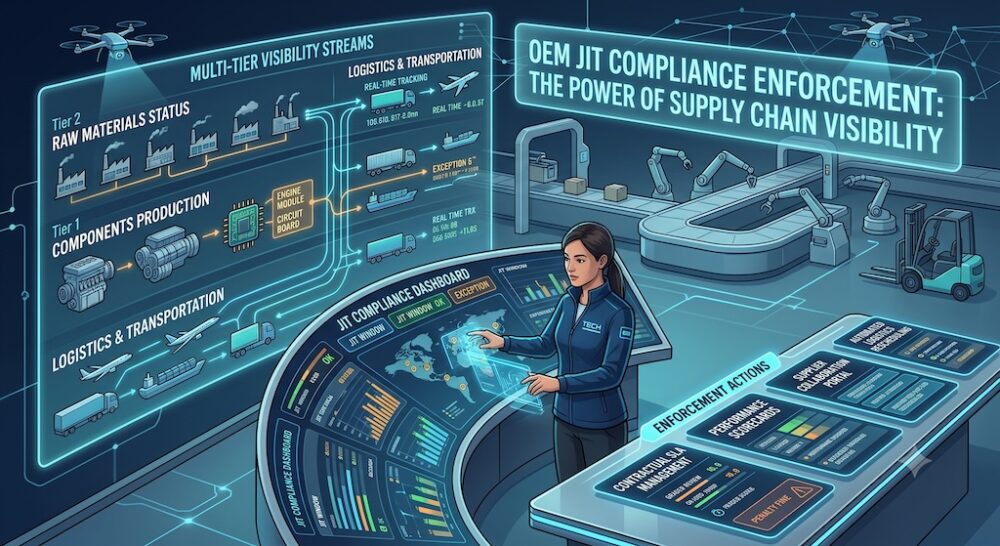
Performance scorecards incorporate delivery accuracy into supplier evaluation alongside quality and cost metrics. Jaguar Land Rover, BMW, and Mercedes measure on-time delivery performance at 30-minute window granularity tracking percentage of arrivals within contracted windows, 1-30 minutes early, 1-30 minutes late, and >30 minutes late. Suppliers consistently delivering outside acceptable windows (typically 95%+ on-time, <1% >30 minutes early or late) receive penalty adjustments reducing contract values 2-5% and reduced future volume allocation. GPS tracking data provides objective evidence preventing supplier disputes claiming traffic excuses or OEM claims of causality.
Visibility platforms enable automatic alternative supplier activation when GPS data indicates delivery delays will exceed 20-minute threshold. OEM planning systems receiving real-time truck position from Tier 1 tracking platform calculate ETA accuracy enabling contingency triggering 60-90 minutes before expected arrival. When traffic conditions indicate 25-35 minute delay approaching, system automatically alerts alternative supplier with different routing option enabling secondary delivery within acceptable window. This redundancy prevents production stoppages when planned supplier cannot meet commitment through no fault of planning.
Cross-docking facility optimization redistributes OEM-bound inventory across multiple plants based on real-time production demand signals. Instead of routing all BMW Dresden production components through single consolidation point (creating congestion and potential delays), tracking visibility enables dynamic allocation sending containers directly to target plants when available inventory exceeds buffer requirements. Audi reports £2.5M annual logistics cost reduction through cross-docking optimization enabled by supplier visibility providing 60-90 minute lead time confirming container content, weight, and ETA before arrival at consolidation hubs.
What production impact results from 15-30 minute supplier delivery delays?
- BMW Dresden production: 2,000 vehicles daily, £25,000 average wholesale value per unit
- JIT inventory buffer: 90-120 minutes (180-240 units in system), delayed component affects next 4-hour production window
- Vehicles affected by 30-minute delay: 500 units = £12.5M production output
- Line downtime labor cost: 800 workers x £40/hour x 0.5 hours = £16,000
- Emergency line restart: 2-4 hours recovery time as inventory depletes before container arrival
- Supplier penalty: £50,000-£150,000 per occurrence (contractual line stoppage damage)
- Lost profit from delayed delivery: £2M-£5M (production rescheduled to next month, premium customers wait)
This £14.5M-£20.65M impact from single 30-minute delay demonstrates why Tier 1 suppliers justify tracking investment. Suppliers achieving 99.5%+ on-time delivery earn Preferred Supplier status entitling them to 3-5 year contract extensions, volume growth allocations, and exemption from price reduction pressures competitors face.
How does returnable pallet management tracking reduce supply chain costs?
Automotive suppliers managing 50,000-200,000 pooled pallets and specialty containers (dunnage, protective cases, component-specific nesting containers) lose 8-15% annually through detention at competing OEM plants, customer retention as scrap, and unauthorized pooling. Bosch operating 150,000 returnable pallets across 12 European OEM customers reports 11-year pallet life expectancy enabling 4-5 container rotations daily. Detention at single OEM facility for 48 hours reduces available pool 10-15% requiring emergency replacement purchases at 20-30% premium costs.
RFID portal scanning at supplier dispatch (asset going out), OEM receiving (asset arriving), and return logistics pickup (asset exiting customer) creates complete visibility detecting detention and loss within 12-24 hours. Suppliers implementing automated detention billing based on RFID scan timestamps (asset sits >24 hours at OEM location) improve recovery from 40-50% to 80-90% through objective documentation preventing customer disputes about when containers arrived. One major supplier charges £15-30 per pallet per day after 24-hour grace period recovering £300,000-£800,000 annually from OEMs retaining excess inventory.
Container pooling optimization enables 20-30% asset reduction through improved velocity visibility. Traditional systems assuming 4-5 day average cycle time invest in sufficient pallets accommodating worst-case supply disruptions. GPS/RFID tracking proving actual average 2.5-3 day cycle eliminates 25-40% contingency inventory. Tier 1 suppliers optimizing pool size from 150,000 to 110,000 pallets eliminate £8M-£15M capital investment in replacement containers while maintaining service levels through demonstrably faster inventory turnover.
What ROI do Tier 1 suppliers achieve from JIT supply chain tracking?
- Baseline: €2.5B Tier 1 supplier managing 12 OEM customers, 1,000-vehicle annual delivery network
- GPS truck tracking investment: £3M (300-1,000 vehicles @ £2,500-5,000 per vehicle)
- Annual GPS operations cost: £600,000 (connectivity, maintenance, software)
- RFID pallet tracking investment: £800,000 (portal readers, gates, software)
- Annual RFID operations cost: £200,000
- Labor reduction (damage claims processing): £180,000
- Detention charge reduction: £600,000
- Container fleet optimization: £1.2M (20% reduction in pooled inventory)
- Supplier penalty avoidance: £500,000 (improved on-time performance)
- Total annual benefit: £2.48M
- First-year investment: £3.8M (hardware) + £0.8M (ops) = £4.6M
- First-year net benefit: £2.48M – £0.8M = £1.68M (excluding hardware depreciation)
- Payback period: 22-24 months | 3-year ROI: 162%
This financial justification excludes significant strategic benefits: contract renewal probability increase from 65% to 92% for suppliers implementing tracking (OEMs trust demonstrated on-time commitment), volume growth allocations averaging 8-12% annually for preferred suppliers, and premium pricing power maintaining margin through competitive pressure preventing typical 3-5% annual price reductions.
Implementation roadmap for automotive supply chain tracking
- Month 1-2: Analyze delivery routes and OEM requirements for 3-5 largest customers
- Month 3-4: Select and install GPS on 25-50 pilot delivery trucks serving highest-volume lanes
- Month 5-6: Deploy RFID readers at primary supplier dispatch yards and return logistics hubs
- Month 7-9: Integration with OEM planning systems, enable visibility to customers
- Month 10-12: Expand GPS to remaining fleet, pilot automatic alternative supplier activation
- Month 13-18: Full RFID network deployment across all distribution facilities and return operations
- Month 19-24: Implement cross-docking optimization and predictive delay detection
Resource requirements: Supply chain director (40% FTE for 24 months), IT integration specialist (50% FTE months 7-15), Operations manager (25% FTE ongoing). Total internal labor: 4,000-5,000 hours across 24-month implementation.
Strategic Tracking connects automotive suppliers with pre-vetted GPS fleet tracking and RFID asset management vendors specializing in JIT supply chain compliance. Our vendor-agnostic consultancy evaluates OEM customer visibility requirements, returnable container management complexity, and integration needs recommending optimal solutions matching automotive-specific operational demands. We provide introductions to established providers ensuring solution selection enables contract compliance and premium supplier status achievement.