

In February 2024 I wrote this article: “5 Reasons Why You Shouldn’t Use Apple Airtags For Shipment Tracking.” A couple of days ago Apple announced the launch of new airtag models. Here is Part 1 of a 2-part series that updates the older article.
What enterprise logistics managers actually need to know about consumer tracking technology
Apple just announced an upgraded AirTag with 50% better range and a louder speaker. Within hours of the announcement, I received three separate inquiries from enterprise buyers asking whether this solves their shipment tracking requirements.
The short answer: No.
The longer answer requires understanding the fundamental differences between consumer item-finding devices and enterprise tracking solutions—a distinction that could save your organization hundreds of thousands in failed implementations.
Why AirTags Are Compelling (And Misleading) for Businesses
I understand the appeal.
AirTags are:
- Inexpensive: £29 per device vs. £50-200 for GPS trackers
- Ubiquitous: Works anywhere there’s an iPhone nearby
- Simple: No subscription fees, no platform complexity
- Familiar: Your team already uses them for keys and wallets
The new version addresses previous limitations with extended range (now functional up to 60 meters vs. 40 meters) and a louder speaker for finding lost items. On paper, this looks like a budget-friendly solution for tracking pallets, shipments, or returnable assets.
Here’s why that thinking leads to expensive failures
New! How To Buy and Implement Tracking Systems 2026 - Free Guide
Based on 20+ years experience of implementing 100s of GPS tracking projects, we have written this easy-to-read best practice guide and checklist to help you plan and implement GPS tracking and realtime visibility solutions. Download Your Free 2026 Guide Here
The Fundamental Problem: Consumer Tech vs. Enterprise Requirements
Over 20 years helping enterprises implement tracking solutions, I’ve watched dozens of companies attempt to use consumer-grade technology for business-critical applications. The pattern is predictable:
Month 1: Enthusiastic pilot. “These work great!”
Month 2: Edge cases emerge. “Why didn’t we get an update for 6 hours?”
Month 3: Compliance audit fails. “We have no audit trail.”
Month 4: Project abandoned. Investment wasted.
Let me explain the specific limitations that cause this failure pattern.
Technical Limitations That Break B2B Use Cases
1. Location Updates Require iPhone Density
AirTags don’t have GPS or cellular connectivity. They depend entirely on nearby iPhones to relay their position to Apple’s Find My network. Enterprise GPS trackers with cellular connectivity provide updates every 15 minutes to hourly regardless of iPhone density. You know where your assets are, not just where iPhones happen to be.
What this means for your shipment:
Urban areas: Frequent updates (iPhones everywhere)
Highways: Sporadic updates (only when passing iPhone users)
Rural routes: Hours between updates (limited iPhone density)
Warehouses: No updates if staff don’t carry iPhones nearby
International shipping: Breaks down completely in markets with low iPhone penetration
Real example:
A UK manufacturer tried AirTags for pallet tracking between Manchester and a rural Scottish facility. Updates worked well through Birmingham and Glasgow. North of Perth?
Eight-hour gaps with zero visibility.
"Schrödinger's pallet—we had no idea if it existed or not until someone with an iPhone walked past."
Logistics Manager
2. No Temperature Monitoring or Environmental Sensors
Condition Monitoring Is Critical For:
Pharmaceutical shipments: GDP compliance requires continuous temperature monitoring with ±0.5°C accuracy and immediate excursion alerts
Food logistics: HACCP audits demand unbroken cold chain documentation
High-value electronics: Impact detection identifies rough handling before damage claims
Clinical trials: Regulatory bodies reject location-only tracking for temperature-sensitive materials
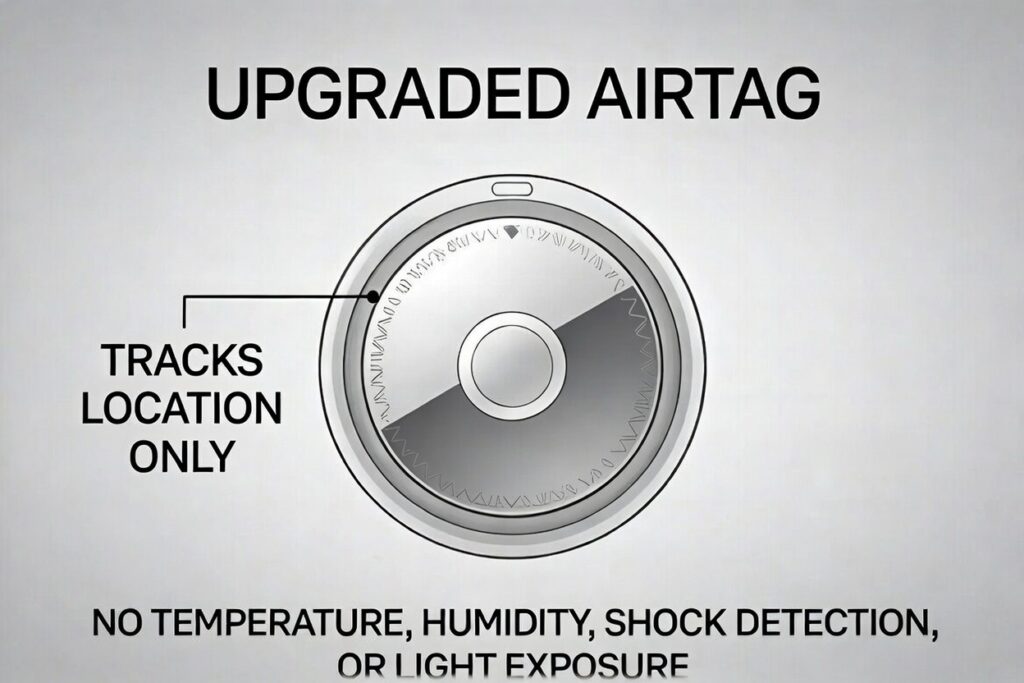
The upgraded AirTag still tracks location only. No temperature. No humidity. No shock detection. No light exposure.
If your use case involves regulatory compliance, controlled environments, or product integrity, AirTags are non-starters. Full stop
3. Privacy Architecture Prevents Business Workflows
Apple designed AirTags with privacy as the paramount concern. Excellent for consumers. Problematic for businesses.
The issue:
– AirTags are tied to individual Apple IDs (personal accounts)
– No centralized business dashboard showing fleet-wide visibility
– No API for integration with ERP, TMS, or WMS systems
– No role-based access control (warehouse manager vs. finance vs. executive)
– No audit logs showing who accessed data when
– Anti-stalking features trigger alerts when AirTags move with non-owners (like your shipment driver who doesn’t own the AirTag)
What enterprise tracking requires:
– Multi-user access with permission hierarchies
– API integration delivering position data to SAP, Oracle, NetSuite
– Automated workflows: geofence alerts → email logistics manager → update delivery ETA in customer system
– Compliance-grade audit trails for ISO, GDP, SOC 2 audits
Consumer privacy protections are features for personal use. They’re roadblocks for business operations.
4. No SLA, No Support, No Accountability
When your pharmaceutical shipment with £500,000 of oncology drugs goes dark for 8 hours because of AirTag connectivity gaps, who do you call?
Apple Support will tell you AirTags are designed for personal item finding, not business logistics. They don’t offer enterprise SLAs. They won’t prioritize your ticket. They have no commercial account managers.
Enterprise tracking vendors provide:
- Guaranteed uptime: 99.5%+ platform availability with financial credits for breaches
- Support SLAs: 2-hour response time for critical issues, 24/7 availability
- Account management: Dedicated contacts who understand your implementation
- Proactive monitoring: Vendor alerts you to device failures before you discover them
When you're tracking assets worth millions or managing compliance-critical shipments, "best effort" consumer support isn't acceptable.
A client
5. Battery Life Optimised for Item Finding, Not Continuous Tracking
AirTags last approximately one year with normal consumer use (periodic location checks when you open the Find My app). Business use cases require continuous monitoring.
The battery drain problem:
– Enterprise shipments need position updates every 15-60 minutes for 2-4 weeks in transit
– AirTags aren’t designed for this update frequency
– Battery replacement mid-shipment is impossible (asset is in transit)
– CR2032 batteries aren’t rechargeable (operational overhead vs. USB-rechargeable enterprise trackers)
GPS trackers designed for logistics last 6-12 months on a single charge with daily position updates, or 2-4 weeks with hourly updates during transit. Purpose-built battery management vs. consumer device repurposed beyond design parameters.
Coming up in Part 2....
In part 2 of this article, I will explore the following:
- When Consumer Tracking Technology IS Appropriate
- The Hidden Cost of “Cheap” Solutions
- What Enterprise Tracking Actually Requires
- Making the Right Choice for Your Use Case
Sign up for our newsletter below to read Part 2
Need Help Evaluating Your Tracking Requirements?
I help enterprise buyers navigate the complex landscape of tracking technology without vendor bias. Whether you’re tracking pharmaceutical shipments, managing returnable asset pools, or implementing warehouse RTLS, I can help you:
– Define requirements that match your actual use case
– Calculate defensible ROI projections
– Identify appropriate technology options
– Make warm introductions to pre-vetted providers
– Avoid implementation pitfalls that waste budget
Get in touch: contact us