Beyond Dots on Maps: Multi-Sensor Anomaly Scoring, Ultra-Thin Reusable 5G Labels, and the 68.5% Automation Milestone
Welcome to Tracking Tuesday 4th August 2026.
As we enter the first week of August 2026, the logistics visibility space has hit an indisputable tipping point: passive tracking without automated anomaly scoring is an operational hazard.
With strategic cargo fraud relying on GPS spoofing and hub throughput accelerating past manual scan limits, visibility must evolve from monitoring location to detecting physical and digital anomalies in real time.
This week, we analyze the convergence of multi-sensor fusion against GPS spoofing, reusable ultra-thin 5G smart labels, and UPS’s milestone throughput acceleration across automated parcel facilities.
Signal Inversion: Why Standalone GPS Invites Strategic Fraud
An executive technical analysis published by security intelligence leader Contguard highlights a critical vulnerability in enterprise visibility: standalone GPS tracking has become a primary vector for organized theft rings using digital identity deception and GPS spoofing.
Strategic cargo fraud now accounts for over 40% of high-value transit losses across North American corridors. Criminals deploy low-cost signal relay boxes or GPS spoofers that broadcast “normal” location pings to a shipper’s Transportation Management System (TMS) while the physical trailer is diverted to a dark warehouse. Because legacy tracking software evaluates coordinates in isolation, the dashboard reports on-schedule status while the freight is actively being stripped.
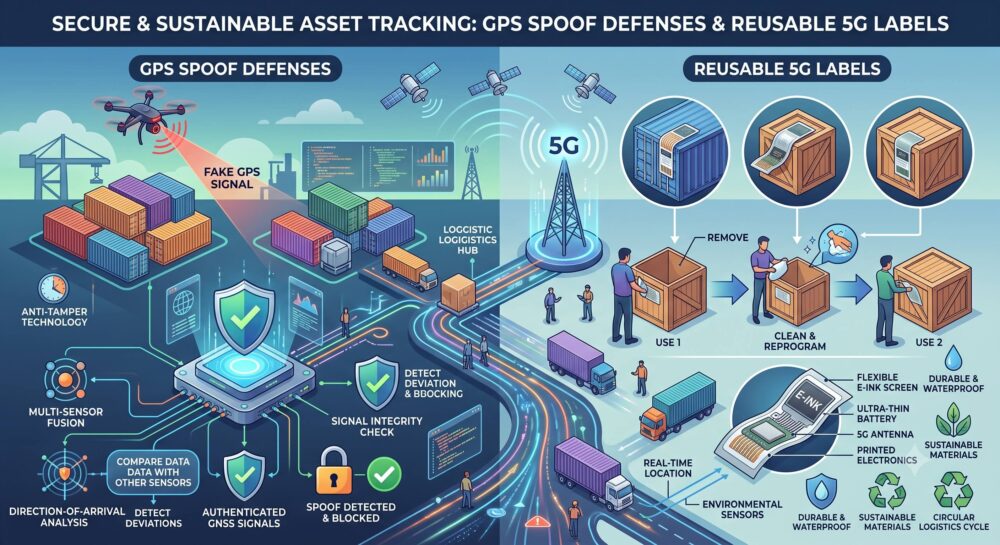
To counter this, modern security frameworks deploy Multi-Sensor Anomaly Scoring. Location pings are continuously cross-referenced with internal light-penetration sensors, multi-axis accelerometers (shock/vibration), door-latch state, and ambient temperature thresholds. If a trailer’s spoofed GPS indicates 65 MPH highway movement, but its internal accelerometer detects zero G-force motion and an internal light sensor detects an unexpected enclosure open event, the ML engine instantly flags a 99% anomaly score, locking down the container and triggering automated emergency recovery teams.
“Standard shipping paperwork and passive GPS pings are completely insufficient… Maintaining complete supply chain integrity demands container-level digital security architectures that provide real-time anti-tampering alerts based on multi-sensor fusion.” — Contguard Security Analysis, 2026.
Single-point location feeds are a liability. If your high-value cargo monitoring relies strictly on dot-on-a-map GPS pings, you are vulnerable to spoofing. Shippers must enforce Multi-Sensor Fusion—demanding IoT systems that validate environmental state alongside location telemetry before clearing security gates.
Reusable Hardware: Lufthansa Industry Solutions & SODAQ Scale 2mm 5G Smart Label
In an upgraded hardware milestone finalized this week, Lufthansa Industry Solutions (LHIND), in partnership with SODAQ and Pod Group (a Giesecke+Devrient company), deployed its commercial Reusable Smart Shipping Label—a 2mm thick, ultra-flexible sensor card capable of up to 30,000 pings across a multi-year operating lifecycle.
Enterprise asset tracking has historically been trapped between two bad choices: bulky, expensive plastic trackers that demand complex return logistics, or fragile single-use stickers with limited sensor capacity. The LHIND/SODAQ smart label resolves this dilemma by integrating a low-power 5G LTE Cat-M chip, printed battery matrix, and multi-sensor array into a paper-thin, postcard-sized device.
Adhering directly to cardboard boxes, roll cages, or high-value envelopes, the label logs continuous temperature, motion, impact, and geofence events directly into LHIND’s LEAP middleware platform. Because the device is removable, rechargeable, and built for multi-year reusability, unit costs drop to pennies per trip without battery disposal liabilities.
Unit-Level Tracking is an Operational Reality. By stripping out heavy plastic enclosures and battery decay penalties while preserving 5G connectivity, high-density item tracking moves from an experimental luxury to an enterprise baseline. Shippers handling pharmaceutical, luxury, or specialized automotive parts can now maintain unbroken telemetry across small-parcel and palletized assets alike.
New! Tracking Tech - Planning, Implementation & Best Practices for 2026
Based on 20+ years experience of implementing 100s of GPS tracking projects, we have written this easy-to-read best practice guide and checklist to help you plan and implement GPS tracking and realtime visibility solutions. Download Your Free 2026 Guide Here
Network Acceleration: UPS Automates 68.5% of U.S. Parcel Volume
In its Q2 2026 operational report released on July 30, 2026, UPS confirmed a major industrial milestone: 68.5% of its total domestic parcel volume now flows through fully automated sorting facilities, up from 64% a year earlier—handling over 337 million additional automated packages.
The carrier currently operates 127 automated facilities, with another 24 scheduled to enter service before the end of 2026. These automated hubs achieve an estimated 28% lower cost per piece by deploying automated induction, high-speed optical scanning, dynamic routing, and robotic sortation. However, high-speed automation introduces a strict technical requirement: parcels move through sortation belts far too quickly for manual barcode alignment or human exception handling.
“Automated induction, scanning, routing, and sortation reduce repetitive handling… but a single failed component or unreadable scan can interrupt thousands of parcels within minutes.” — UPS Network Operations Briefing, July 2026.
Automation demands clean, active edge telemetry. As major carriers shift over two-thirds of parcel volume through automated hubs, packages with damaged barcodes or unreadable labels face immediate automated ejection into delay queues. Shippers must integrate RFID/BLE smart labels to ensure high-speed sorters read package identity instantly at 10+ feet per second.
Supplier Quick Quotation Request
🌌 IDEA FOR THE FUTURE: THE “AUTONOMOUS SORT SANCTUARY” (ASS)
The Concept: A self-verifying mid-mile routing system that pairs reusable 5G smart labels with automated hub sorters to instantly detect and trap spoofed or misrouted cargo.
How it Works: To eliminate GPS spoofing and mid-mile automated misrouting, high-value packages are affixed with a Lufthansa-SODAQ Reusable 2mm Smart Label. As the parcel enters a UPS-style automated facility handling 68.5% automated volume, high-speed RFID/5G induction gantries execute an instantaneous dual-check:
-
The facility scanner reads the printed barcode and package weight.
-
The edge sorter queries the label’s Contguard Anomaly Score.
If the label’s internal accelerometer or light sensor logs an unauthorized door open event or a sudden G-force shock while the external carrier GPS claimed the trailer was smoothly cruising, the automated sorter’s robotic arm instantly diverts the parcel into a locked “Security Isolation Bin.” The system automatically halts payout transfers, alerts the shipper’s SOC, and logs cryptographically signed sensor evidence for federal investigators.
The Strategic Why: It converts mid-mile sorting speed into an active security perimeter. Physical sensor logic and high-speed facility automation team up to intercept hijacked cargo before it ever leaves the transit node.
📅 INDUSTRY EVENTS
-
Jarrett Supply Chain Summit 2026
-
Date: August 5–6, 2026 | Location: Cleveland, OH
-
Strategic Focus: Senior shippers, carriers, and 3PL leaders exchange tactical playbooks on freight fraud mitigation, transportation technology, and real-time visibility partnerships.
-
-
ASCM Webinar: Supply Chain Resiliency & Fraud Defense
-
Date: Thursday, August 13, 2026 | Location: Virtual/Global
-
Strategic Focus: Tactical countermeasures against $1B organized theft rings, fraudulent CDL accounts, and multi-layered carrier vetting protocols.
-
-
CBP Trade and Cargo Security Summit (TCSS) 2026
-
Date: September 8–10, 2026 | Location: Dallas, TX / Virtual
-
Strategic Focus: U.S. Customs and Border Protection summit bringing together government and trade leaders on international cargo security, CTPAT, ACE helpdesk, and trade compliance.
-
-
CSCMP EDGE 2026 Supply Chain Conference
-
Date: September 20–23, 2026 | Location: Nashville, TN
-
Strategic Focus: The premier Q3 gathering covering closed-loop high-security networks, dual-GPS drop-trailer fleets, and agentic AI visibility platforms.
-
-
4–17 September Pharma Logistics Masterclass, Frankfurt and Antwerp Pharma manufacturers, airports, forwarders and cold-chain decision-makers. 23–24 September Parcel+Post Expo, ExCeL London Highest-priority UK event for parcel monitoring, labels, scanning and last-mile technology. 5–6 October Gartner Supply Chain Planning Summit, London Senior supply-chain buyers and potential platform partners.