Sensolus recently ran a webinar on multimodal transport tracking — following goods as they move across truck, rail and sea without swapping devices or losing visibility at each handover. It’s a good prompt to look at multimodal tracking as a category, not a product pitch: what the problem actually is, why it’s harder than it sounds, and what to interrogate before you buy from anyone in this space.
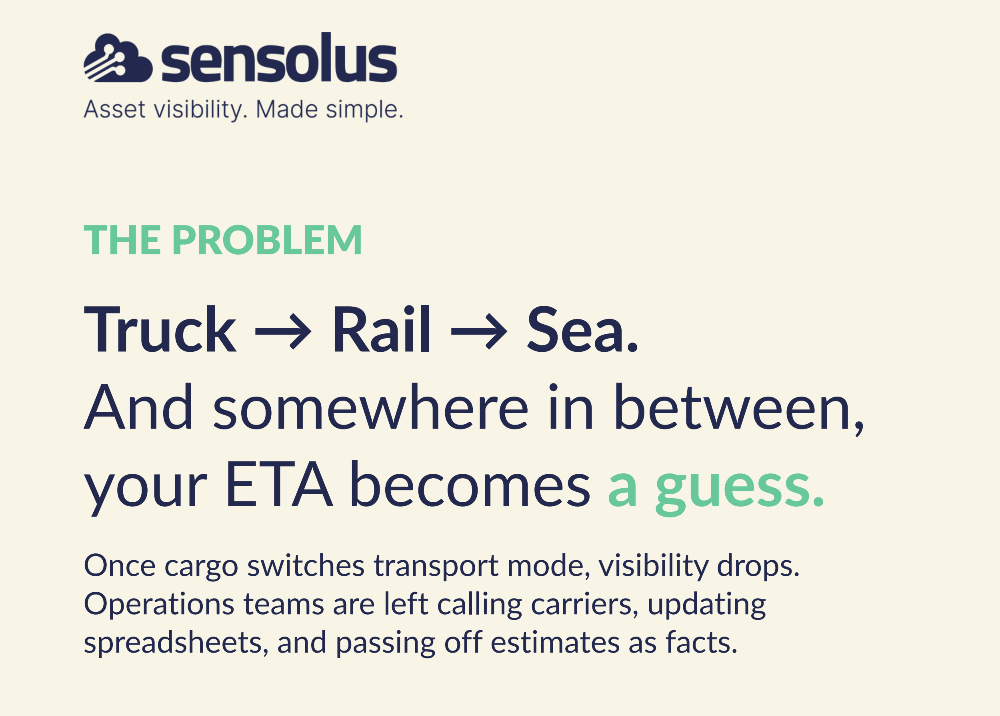
The problem isn't tracking. It's the handovers.
Most asset trackers are built for one environment. GPS units do well on the open road. BLE beacons work indoors or in dense yards. Satellite modules cover the ocean leg when there’s no cellular signal at all. The trouble starts the moment an asset crosses from one of those environments into another.
A container that leaves a factory by truck, transfers to a train, then boards a vessel typically passes through three different tracking regimes — and, in a lot of set-ups, three different systems, three different data formats, and a manual reconciliation job for whoever has to stitch the journey back together. That’s where visibility gaps, blind spots during transfer windows, and “where did it go for six hours” conversations come from.
What a genuine multimodal solution needs to do
Strip away the marketing and there are four capabilities that actually separate a multimodal tracking solution from a single-mode tracker with a multimodal label on it:
- Automatic mode detection — the device itself recognises whether it’s on a truck, a train or a ship and adjusts its reporting behaviour (frequency, positioning method, power draw) without anyone touching it.
- Connectivity that spans the journey — a mix of cellular, satellite and BLE/Wi-Fi positioning, because no single technology covers road, rail and open sea equally well.
- Battery life built for the whole trip — a transatlantic or multi-leg journey can run weeks; a device that’s back in the office for a battery swap halfway through the crossing isn’t a multimodal solution.
- One data model, one dashboard — the value is in a continuous journey history, not three exports that someone has to merge in a spreadsheet.
Sensolus’s pitch — industrial-grade trackers that detect the transport mode automatically and adjust behaviour accordingly — lines up with that checklist. So do a handful of others building in this space. The point isn’t that one vendor has cracked it and the rest haven’t; it’s that these four criteria are the right test to apply to anyone in this category.
Questions worth asking any multimodal tracking vendor
- How does mode detection actually work — accelerometer-based inference, geofencing, manual tagging, or a genuine hybrid? Ask for a failure case, not just the happy path.
- What happens in a dead zone — mid-Atlantic, a tunnel, a below-deck container stack? Is there a data gap, or does the device store-and-forward?
- What’s the real battery life under multimodal load, not the single-mode marketing figure?
- Is the platform genuinely unified, or is “one dashboard” three integrations wearing the same skin?
- What’s the total cost of ownership across a full round trip, including any per-leg or per-mode data charges?
Who this actually matters for
Multimodal visibility isn’t a nice-to-have for everyone. It earns its keep for international logistics and freight-forwarding operations running intermodal or Ro-Ro flows, industrial manufacturers shipping heavy equipment across regions, and ports or depots managing the handover point itself — the exact moment most tracking set-ups go dark.
If your assets never leave a single mode of transport, a simpler single-technology tracker will do the job for less. The multimodal case is specifically for the handover problem.
The bigger picture
This sits inside a wider shift I’m tracking across supply chain visibility generally: buyers are moving away from “pick a tracker” and toward “pick a visibility strategy,” where the technology adapts to the asset’s journey rather than the journey being forced to fit the technology. Multimodal transport tracking is one of the clearer examples of that shift actually showing up in product design, rather than just in vendor slide decks.
As always — I work across the tracking and telematics market without a fixed allegiance to any one vendor, so if you’re evaluating multimodal tracking for your own operation and want a second opinion on what’s genuinely differentiated versus what’s repackaged, that’s exactly the kind of conversation I’m set up to have.