Clinical trial temperature monitoring should be selected according to product risk, shipment recoverability and the organisation’s ability to intervene. A calibrated USB or PDF data logger may be sufficient when retrospective evidence is the primary requirement. Real-time monitoring becomes more valuable when an alert can help prevent loss, redirect a delayed shipment or accelerate a documented operational response.
The important distinction is not simply “logger versus tracker”. It is whether live data will lead to a defined, timely and useful action.
Key takeaways
- Conventional data loggers remain suitable for many predictable, validated clinical-supply lanes.
- Real-time monitoring is most valuable when someone can intervene before an excursion or delay becomes unrecoverable.
- Device accuracy alone does not create an effective monitoring programme. Packaging, placement, connectivity, alert ownership, standard operating procedures and data review all matter.
- An out-of-range sensor reading does not automatically determine whether an investigational medicinal product, or IMP, remains suitable. It initiates assessment against the applicable product information, stability evidence and quality procedures.
- Low unit price can be misleading if a device is difficult to activate, retrieve, download, integrate or investigate.
- A controlled pilot should test the complete response process, not merely whether the tracker produces location and temperature readings.
When is a conventional temperature logger sufficient?
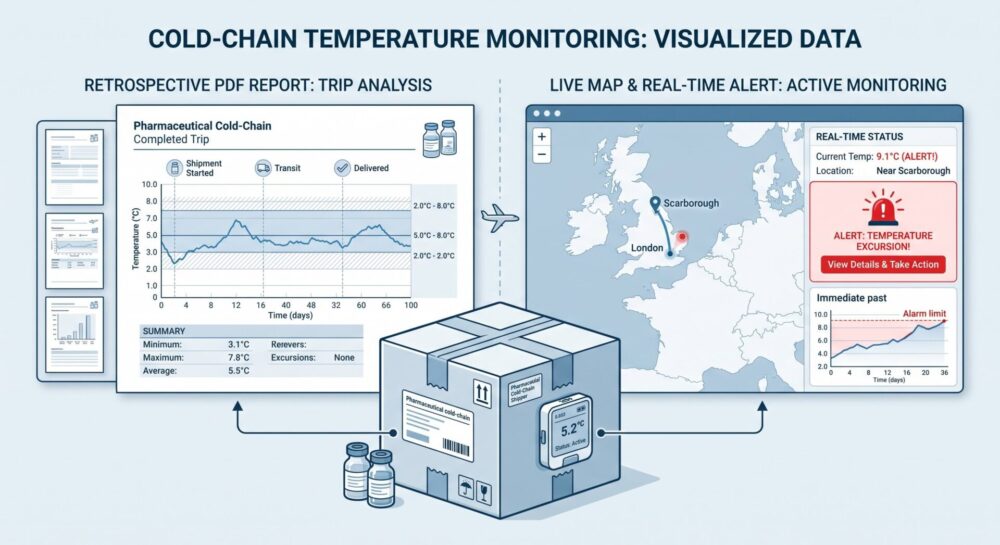
A conventional data logger is often sufficient when the route is stable, the packaging system is well characterised, the shipment can tolerate the expected journey duration and no practical intervention is possible during transit. It produces a temperature record that can be reviewed when the consignment reaches the depot or clinical site.
This can be an appropriate and proportionate approach for:
- Qualified, repeatedly used transport lanes
- Reliable depot-to-site distribution
- Products with established stability information
- Short journeys with generous packaging duration
- Shipments where replacement stock is readily available
- Operations primarily requiring evidence at receipt
- Consignments carried through controlled specialist networks
A data logger records conditions internally. Depending on its design, the recipient may connect it to a computer, scan it, use near-field communication or retrieve a PDF report.
This approach is relatively simple and can be economical at volume. However, it normally reveals a problem after the shipment has arrived. If a parcel remains at customs, is routed to the wrong facility or is left in an uncontrolled reception area, the sponsor may not know until the receiving team reports it.
The MHRA’s guidance on refrigerated medicinal-product transportation recommends routine temperature monitoring for refrigerated deliveries, particularly high-risk products, using calibrated probes to provide data for the journey. It also stresses the need to review records and maintain procedures for adverse events.
That supports monitoring and documented review. It does not mean every shipment must use a cellular real-time tracker.
When does real-time clinical trial temperature monitoring add value?
Real-time clinical trial temperature monitoring adds value when an emerging problem can still be corrected. The technology should provide enough warning—and enough contextual information—for an authorised person to take an effective action.
Examples include:
- Asking a courier to move a parcel from an uncontrolled area
- Escalating a customs or clearance delay
- Correcting delivery to the wrong clinical site
- Confirming whether a direct-to-patient recipient is available
- Replenishing or replacing coolant during an extended delay
- Diverting a shipment to an approved depot or storage location
- Preparing replacement stock before the original shipment arrives
- Warning the receiving site that immediate handling is required
The European Commission’s guidance on sponsor responsibilities for handling and shipping IMPs states that transport and storage conditions require temperature monitoring and that records should be maintained and evaluated at delivery. ICH E6(R3) also identifies documentation of investigational-product storage conditions, including during shipment, as an essential record.
Neither source should be interpreted as an automatic endorsement of one device class. The monitoring design should be based on the product, trial, lane, packaging and operating risks.
The intervention test
Before paying for live connectivity, ask:
If this alert reaches us now, is there an approved and realistic action that could improve the outcome?
If the answer is no, real-time data may still accelerate assessment or improve visibility, but its loss-prevention value will be limited.
If the answer is yes, define who acts, how quickly they must respond and which parties they are authorised to contact. Without those decisions, the tracker can become an expensive live alarm that nobody owns.
Data logger versus real-time shipment tracker
| Decision factor | Conventional data logger | Real-time shipment tracker |
|---|---|---|
| Data availability | Usually at receipt or after retrieval | During transit, subject to connectivity |
| Temperature record | Yes | Yes, with remote transmissions |
| Location visibility | Usually none | Cellular, GNSS, Wi-Fi, Bluetooth or network-derived |
| In-transit intervention | Limited | Potentially possible |
| Customs and delay detection | Usually indirect | Possible through location and dwell data |
| Operational complexity | Lower | Higher |
| Alert management | Usually review at receipt | Requires owners, thresholds and escalation |
| Connectivity dependence | None during recording | Needed for live updates |
| Typical cost | Lower | Higher, sometimes including connectivity and platform fees |
| Best fit | Predictable, lower-risk or non-intervenable lanes | High-risk, recoverable or operationally complex shipments |
Some devices combine both models. A cellular tracker may continue recording when it cannot connect and upload the missing readings later. A Bluetooth sensor can also provide cost-effective monitoring where gateways, mobile applications or fixed readers are available.
The right architecture may therefore use several device types rather than impose one technology on every shipment.
A realistic IMP shipment scenario
Consider a 2–8°C investigational medicinal product travelling from a European clinical-supply depot to a research site in another country. The validated packaging is designed for 72 hours, while the planned delivery time is 24 hours.
The consignment reaches the destination country but remains at a customs facility. The courier’s milestone feed continues to show “in transit”, while a real-time tracker indicates that the parcel has not moved for eight hours. Its internal temperature is still within range but is gradually rising.
A properly designed response might proceed as follows:
- The monitoring platform identifies prolonged dwell and temperature trend, rather than waiting for a high-temperature threshold alone.
- The designated clinical-supply contact verifies the tracker reading and shipment identity.
- The logistics provider investigates the customs hold.
- The receiving site is warned that delivery may occur outside normal hours.
- If necessary and procedurally permitted, the logistics provider arranges controlled interim storage or another approved action.
- Quality personnel receive the complete temperature record and operational history for assessment.
The tracker has not declared the IMP acceptable, released it for use or provided regulatory compliance. It has supplied earlier evidence and additional time in which qualified people may act.
Had the journey been short, predictable and impossible to influence, a calibrated electronic logger might have provided all the evidence reasonably required.
What should an IMP monitoring architecture include?
1. Device and sensor
Start with the measurement requirement, not the product brochure.
Evaluate:
- Required temperature range
- Accuracy, resolution and recording interval
- Calibration status and documentation
- Battery duration under realistic transmission settings
- Start-up, activation and stop procedures
- Device placement inside or outside the packaging
- Suitability for air transport and destination markets
- Single-use, returnable or reusable operation
- Additional sensors such as light, shock, humidity or orientation
A sensor placed next to coolant can report a different condition from one placed near the product payload. Placement should reflect the monitoring objective and packaging qualification evidence.
2. Connectivity and location
Cellular devices can provide wide-area communication, but coverage is not universal. Aircraft holds, insulated packaging, basements, depots and remote clinical sites may interrupt transmission.
Bluetooth devices generally require a compatible mobile application, gateway or reader. GNSS can provide useful outdoor positioning but may perform poorly inside buildings or vehicles. Wi-Fi-based location can help identify indoor or urban locations without connecting to the Wi-Fi network.
Buyers should ask what happens when the device loses coverage. It should continue recording locally and reconcile the data when communication returns.
3. Packaging and lane qualification
A tracker cannot compensate for unsuitable thermal packaging.
The packaging design should address:
- Product temperature range
- Seasonal profiles
- Expected and worst-case journey duration
- Payload configuration
- Coolant conditioning
- Customs and weekend delays
- Opening events
- Last-mile handover
- Direct-to-patient delivery variability
The MHRA’s temperature-mapping guidance recommends that sponsors use a risk assessment to determine storage requirements and the type and level of monitoring needed when shipping IMPs to investigator sites.
4. Alerting and escalation
More alerts do not necessarily create better control.
Define:
- Warning and critical thresholds
- Permitted duration outside a target band
- Temperature trend or rate-of-change alerts
- Dwell, route and arrival events
- Alert recipients by region and time zone
- Out-of-hours coverage
- Acknowledgement and escalation times
- Rules for suppressing duplicates
- Who may contact the courier, depot, site or patient
Product-specific quality decisions should remain within the authorised quality process. Operational teams should not infer product disposition from a dashboard colour.
5. SOPs and training
A standard operating procedure should explain activation, packing, shipment association, alert response, receipt, data review, deviation handling and record retention.
Training must include realistic exceptions:
- The device was not activated
- A site received the shipment but not the alert
- The tracker stopped transmitting
- The logger report cannot be downloaded
- The parcel arrived outside pharmacy hours
- An alarm occurred without an obvious temperature excursion
- The platform and courier record show different locations
6. Data integration
Clinical trial shipment tracking can become fragmented across courier portals, logger PDFs, interactive response technology, depot systems, spreadsheets and email.
Integration priorities may include:
- Shipment and kit identifiers
- Origin, destination and site
- Device-to-shipment association
- Courier milestones
- Temperature and location events
- Alert acknowledgement
- Deviation-investigation references
- Data export and audit history
- Role-based access and retention requirements
The goal is not necessarily to integrate everything immediately. It is to prevent ambiguity over which device, shipment, product and response record belong together.
Who should receive real-time shipment alerts?
Alerts should go to people with the context, authority and availability to respond. Sending every notification to the sponsor, CRO, courier, depot and site simultaneously can create duplication and unclear ownership.
A practical escalation model might be:
- Logistics control receives operational delay and dwell alerts.
- The depot or clinical-supply team receives shipment and delivery exceptions.
- The site receives actionable arrival or handling notifications.
- Quality receives defined excursion events and supporting evidence.
- The sponsor receives escalations based on severity and study procedures.
Direct-to-patient deliveries require additional privacy and communication controls. Location visibility should be limited to what is operationally necessary, with access and retention designed accordingly.
Common mistakes and limitations
Buying entirely on unit price
The cheapest tracker may create higher programme costs if activation failures, poor coverage, manual downloads, platform charges, unusable reports or support demands are ignored.
Compare total operational cost, not only hardware price.
Treating live monitoring as automatic compliance
A tracker supplies evidence. It does not validate the packaging, approve an excursion, replace an SOP or make a product-disposition decision.
Setting alert thresholds without response rules
An alert is useful only when recipients understand what it means and what they are expected to do.
Assuming connectivity is continuous
Live devices will encounter transmission gaps. The programme must distinguish a communications gap from a monitoring gap.
Ignoring clinical-site workload
Site personnel may have limited time, restricted IT access and unfamiliarity with each device. Activation and download steps should be simple and tested with representative users.
Piloting only the hardware
A technically successful tracker trial can still conceal operational failure. A pilot should deliberately test alerts, escalation, weekend coverage, data reconciliation and deviation evidence.
Clinical trial monitoring pilot checklist
- Define the product, temperature band and shipment risks.
- Select representative lanes, sites, packaging and seasons.
- State what success means before the pilot begins.
- Compare logger and real-time options where appropriate.
- Verify calibration, recording and battery requirements.
- Test device placement and communication from inside the packaging.
- Assign alert owners and escalation times.
- Simulate a delay, connectivity loss and temperature warning.
- Assess site activation and receipt procedures.
- Reconcile tracker, courier and shipment records.
- Review false alarms, missing data and manual workload.
- Decide whether benefits justify programme-wide cost and complexity.
Frequently asked questions
Is real-time temperature monitoring required for every IMP shipment?
Not necessarily. Monitoring should reflect the product, protocol, stability information, packaging, lane and risk assessment. A calibrated conventional logger may be proportionate where retrospective evidence is sufficient and intervention during transit is not feasible.
What is a temperature excursion in clinical-trial logistics?
A temperature excursion is an exposure outside the applicable defined conditions that requires assessment under the organisation’s quality procedures. A sensor alarm should trigger review; it does not by itself determine whether the IMP is unsuitable for use.
Can a cellular tracker continue recording without mobile coverage?
A suitable tracker should record readings locally during a communication gap and transmit them when coverage returns. Buyers should verify memory capacity, sampling behaviour and how delayed data are presented.
Where should the temperature sensor be placed?
Placement depends on the packaging design and monitoring objective. It should be established with reference to packaging qualification and the location that provides meaningful evidence about product conditions, rather than simply choosing the easiest place to attach the device.
What should a clinical-trial shipment-monitoring pilot measure?
It should measure data completeness, temperature accuracy, connectivity, alert timing, response performance, user workload, integration feasibility and total cost. It should also test whether earlier information leads to a better operational decision.
Selecting the right monitoring approach
Effective clinical trial temperature monitoring is not a contest between an inexpensive logger and an advanced real-time tracker. It is a risk-based decision about what must be measured, when the data must become available and what the organisation can do with it.
Strategic Tracking helps pharmaceutical, biotech, CRO, clinical-supply, logistics and quality teams diagnose monitoring and shipment-visibility requirements; compare appropriate tracking and sensing technologies; and design controlled pilots. We can also help connect devices, data, alerts and operational workflows.
The objective is not to add technology for its own sake. It is to avoid selecting a product solely because it appears inexpensive, and to establish a monitoring system supported by correct technology selection, appropriate processes, implementation expertise and an effective response to the data.