Satellite-Enabled Bluetooth Is Impressive—but Industrial Asset Tracking Needs More Than Connectivity
What if a standard Bluetooth Low Energy device could transmit data directly to a satellite hundreds of kilometres above Earth?
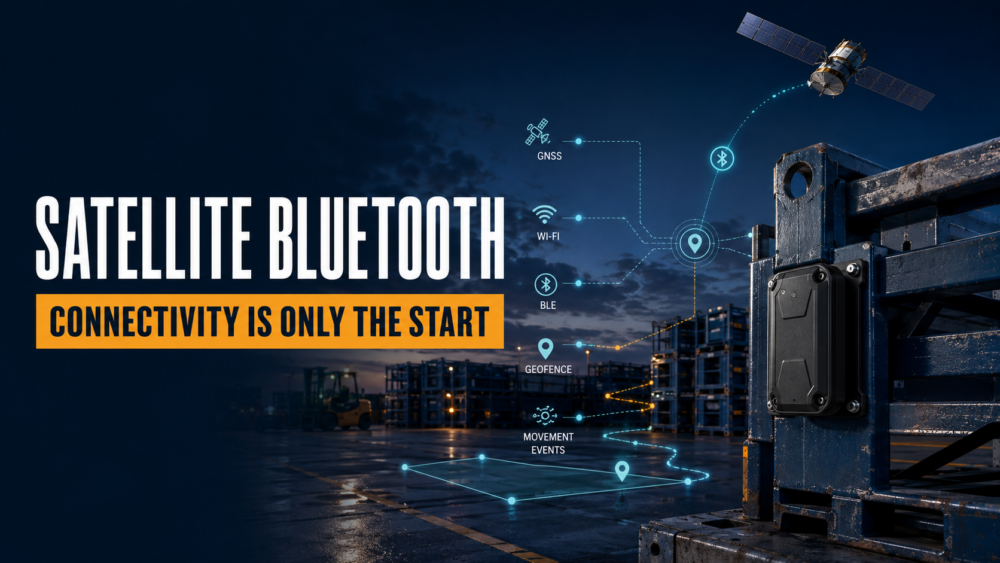
That is the proposition behind Hubble Network’s work with Silicon Labs. Using compatible Bluetooth-class silicon, including the Silicon Labs EFR32MG24, Hubble has demonstrated direct-to-satellite transmission without adding a conventional satellite modem. The same approach is being combined with a large terrestrial gateway network to collect small packets of sensor and status data.
It is an important development for the Internet of Things. Lower-cost, lower-power satellite connectivity could eventually make remote sensing and asset telemetry possible in places where cellular and local wireless networks are unavailable.
However, businesses evaluating tracking for reusable containers, trailers, stillages, tools, returnable packaging and other non-powered assets should make one critical distinction:
Connectivity is not the same as an operational asset-tracking solution.
A radio signal may move data from a device to the cloud. It does not, by itself, tell a logistics team which assets are available, how long they have remained at a customer site, whether a container has entered the wrong depot, when equipment is due for maintenance or how many additional assets the business actually needs.
This is where an established industrial platform such as Sensolus has a practical advantage.
What Hubble Network has achieved
Hubble Network’s technical achievement should not be understated. In March 2024, the company successfully decoded a transmission from a standard Bluetooth chip over a distance of more than 600 kilometres. Its software uses a proprietary long-range protocol on compatible Bluetooth silicon, while its satellites carry specialised receiver arrays capable of detecting the low-power signal.
According to Silicon Labs’ Hubble Network case study, Hubble currently has seven capable satellites in orbit and guarantees a global satellite contact at least once per day. The platform can carry small telemetry payloads and forward data through APIs and webhooks. Hubble plans to begin launching a new generation of satellites in 2027, with continuous global coverage intended once a 60-satellite constellation is operational.
This creates interesting possibilities for remote environmental sensors, agricultural monitoring, fixed infrastructure and assets that only need to send occasional status messages.
But it is important to interpret the headline correctly. “Bluetooth from almost anywhere” does not necessarily mean continuous, precise or indoor asset visibility from everywhere.
Satellite connectivity does not remove the physical limitations
Satellite systems need a usable radio path between the device and the satellite. Roofs, industrial buildings, dense urban infrastructure and metal enclosures can obstruct or attenuate the signal.
Silicon Labs explicitly notes that satellites may not be the best solution for assets located indoors or inside metal containers, unless terrestrial gateway coverage is available. Current satellite contact frequency is also different from the frequent, event-driven reporting many industrial operations expect when an asset moves, arrives, departs or overstays.
There is another important distinction: transmitting a sensor packet and establishing the operational location of an asset are separate functions. A communications network can hear a device, but the application still needs an appropriate method of positioning it and converting the observation into useful business context.
For industrial asset management, the buyer should therefore ask more than, “Can the device connect?”
The better questions are:
- Can it determine its position outdoors and indoors?
- Can it detect movement, arrival, departure and dwell?
- Can it preserve data when network coverage disappears?
- Can it operate for years without charging?
- Can the hardware survive the environment in which it is installed?
- Can the information drive a real workflow inside the business?
- Is the complete system already proven at industrial scale?
The Sensolus advantage: multiple technologies working as one system
Sensolus is designed specifically for long-term visibility and management of reusable, non-powered industrial assets.
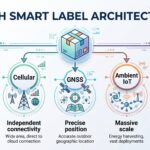
Rather than relying on one positioning or communication method, selected Sensolus smart trackers combine GNSS, Wi-Fi geolocation and Bluetooth. Outdoors, GNSS provides a location fix. Indoors or under cover, the tracker can use nearby Wi-Fi signals or BLE infrastructure to establish its location or zone. It then sends data to the Sensolus platform over low-power cellular networks such as LTE-M or NB-IoT.
The tracker selects the appropriate method according to its environment and operating state. It can report more frequently when an asset is moving and reduce activity when it is stationary. Sensolus states that suitable configurations can deliver battery life of up to ten years, depending on tracker, configuration, network conditions and asset behaviour.
This hybrid approach matters because industrial assets rarely remain in ideal conditions. A returnable rack may leave a factory, travel on a lorry, enter a warehouse, sit under a loading canopy, move to a customer site and remain dormant for several weeks. No single location technology performs equally well across every stage.
From dots on a map to operational decisions
Many tracking demonstrations finish when a device appears on a map. In practice, that is where the operational work begins.
The Sensolus platform turns location and movement data into information that asset owners can act upon, including:
- Arrival and departure events at defined geozones
- Dwell-time and overstay alerts
- Movement and journey histories
- Asset inventory and availability by location
- Utilisation reporting
- Battery and device-health monitoring
- Maintenance and inspection workflows
- Exception alerts when an asset behaves unexpectedly
This helps organisations answer business questions rather than merely technical ones:
- Which containers are ready for collection?
- Which stillages have remained at a customer site for too long?
- Do we have enough rolling cages at the depot for tomorrow’s demand?
- Which pieces of equipment are idle or underused?
- Are we buying replacement assets because the existing pool is poorly distributed?
- Which asset needs inspection before it is used again?
That difference—between receiving a transmission and improving a process—is central to the business case for industrial tracking.
Proven for large reusable-asset populations
Industrial tracking also has to scale beyond a laboratory demonstration or small pilot.
Sensolus cites deployments covering approximately 450,000 DHL rolling cages and 400,000 Deutsche Post letter trolleys, while logistics operator Ampère uses the system with 8,000 rolling containers. These examples involve high-volume asset pools where availability, dwell time and redistribution directly affect operating capacity. Sensolus’s transport and logistics overview provides further details.
Other published use cases cover waste containers, trailers, aerospace jigs, returnable transport packaging and industrial equipment. The value is not simply that the assets can be found. It is that movement data supports fleet sizing, asset recovery, utilisation improvement and operational automation.
Integration matters as much as hardware
An asset-tracking system should not become another isolated dashboard that employees must remember to check.
Sensolus provides a documented REST API, HTTP and MQTT callbacks, data exports and connections with enterprise and analytics platforms. Asset location, movement, utilisation and maintenance information can therefore be brought into ERP, fleet-management, business-intelligence and operational systems.
The Sensolus integration framework supports both directions: business data such as ownership, shipment references or cost centres can enrich the tracking platform, while asset events can trigger workflows in the customer’s existing environment.
For a large deployment, these capabilities are often more important than the novelty of the underlying radio. The objective is not to create more location data; it is to reduce manual searches, telephone calls, spreadsheet updates, replacement purchases and operational delays.
Satellite Bluetooth and Sensolus are not necessarily competitors
It would be a mistake to conclude that satellite-enabled Bluetooth has no role in the future of industrial IoT. It could become a valuable additional communications layer for remote assets, particularly when payloads are small and reporting can be intermittent.
Over time, satellite reception, terrestrial crowdsourced gateways, cellular IoT, Wi-Fi geolocation, GNSS and private BLE infrastructure may increasingly complement one another.
The immediate purchasing question, however, is not which radio technology sounds most revolutionary. It is which system solves the organisation’s operational problem with an acceptable level of coverage, battery life, reliability, deployment effort and total cost.
A practical comparison
| Requirement | Satellite-enabled BLE proposition | Sensolus industrial asset tracking |
| Primary innovation | Low-power data transmission through satellites and terrestrial gateways | End-to-end visibility and management of non-powered assets |
| Current satellite reporting | At least one guaranteed global contact per day, according to Silicon Labs | Event-driven data over LTE-M or NB-IoT where supported, with onboard recovery after gaps |
| Outdoor positioning | Depends on device design and application architecture | GNSS integrated into selected smart trackers |
| Indoor visibility | Requires suitable terrestrial gateway availability | Wi-Fi geolocation and BLE zone infrastructure supported |
| Metal enclosures | Satellite path may be obstructed | Multiple positioning methods and stored-event recovery mitigate, but mounting and coverage still require testing |
| Battery strategy | Low-data-rate transmission designed for low power | Movement-aware tracking configurations with up to ten years claimed for suitable deployments |
| Operational workflows | Platform, APIs and webhooks for device data | Geozones, dwell, utilisation, inventory, maintenance, alerts, reporting and device management |
| Deployment maturity | Emerging satellite and terrestrial connectivity ecosystem | Established industrial deployments across large reusable-asset fleets |
The two approaches are not strictly equivalent: one primarily extends the communications options available to device developers; the other is a complete industrial asset-tracking solution for operators.
When Sensolus is the stronger practical fit
Sensolus is particularly relevant when an organisation needs to manage reusable assets over several years and the problem involves more than occasional telemetry.
Typical applications include:
- Returnable packaging, stillages and transport racks
- Rolling cages, pallets and load carriers
- Trailers, swap bodies and containers
- Waste containers and skips
- Industrial tools and mobile equipment
- Aerospace tooling and ground-support assets
- Construction equipment and material-handling assets
The strongest business cases usually involve a combination of lost visibility, excessive dwell, poor utilisation, manual administration, unnecessary replacement purchases or difficulty recovering assets from customer locations.
The conclusion: buy the operational outcome, not the radio headline
Hubble Network’s satellite-enabled Bluetooth technology is a significant engineering development. It expands the future connectivity options available to manufacturers of low-power devices and may open valuable new remote-monitoring use cases.
But industrial asset tracking is not solved by connectivity alone.
For businesses that need dependable, long-term visibility of reusable and non-powered assets across factories, warehouses, yards, roads and customer sites, Sensolus offers the advantage of a mature end-to-end system: rugged autonomous hardware, hybrid positioning, intelligent power management, event and dwell detection, device management, operational workflows and enterprise integration.
The most useful question is therefore not, “Can Bluetooth reach a satellite?”
It is:
“Can the tracking system help us recover assets faster, reduce idle time, improve availability and operate a smaller, better-utilised asset pool?”
That is where industrial asset tracking creates measurable value.
Do you manage reusable, mobile or non-powered assets across multiple sites?
Strategic Tracking can help you assess whether Sensolus is technically and commercially suitable for your asset population. We can review the assets, operating environment, required visibility, deployment scale and potential return on investment before recommending a pilot.
Explore industrial asset tracking or contact Strategic Tracking to discuss your use case.
FAQ
What is satellite-enabled Bluetooth tracking?
Satellite-enabled Bluetooth tracking uses a specialised long-range protocol and satellite receivers to collect small data packets transmitted by compatible Bluetooth-class devices. It can extend low-power device connectivity beyond conventional local Bluetooth range, although reporting frequency and coverage depend on the satellite constellation, device design and operating environment.
Does satellite Bluetooth provide continuous real-time asset tracking?
Not necessarily. Silicon Labs currently describes Hubble Network as guaranteeing at least one satellite contact per day globally, with continuous coverage planned for a future 60-satellite constellation. Terrestrial gateways may provide additional connectivity where available.
What technologies do Sensolus trackers use?
Selected Sensolus smart trackers combine GNSS, Wi-Fi geolocation and Bluetooth for positioning, with LTE-M or NB-IoT for data transmission. The precise capabilities depend on the tracker model and deployment configuration.
How long can a Sensolus tracker battery last?
Sensolus states that suitable tracker configurations can achieve up to ten years of battery life. Actual life depends on the device model, reporting frequency, movement patterns, signal conditions, temperature and other deployment factors.
What types of assets are suitable for Sensolus?
Sensolus is designed for reusable, mobile and non-powered industrial assets such as containers, trailers, stillages, returnable packaging, rolling cages, waste containers, tools and industrial equipment.