Choosing between RFID, barcode, and Bluetooth Low Energy (BLE) for warehouse asset tracking is one of the most common — and most consequential — decisions logistics and operations leaders face. Get it wrong, and you either overspend on infrastructure you didn’t need or under-deliver on the visibility the business actually required. Below are direct answers to the questions we’re asked most often, followed by a practical framework for choosing.
Is RFID suitable for tracking metal assets?
Direct answer: RFID can track metal assets, but standard tags perform poorly near or on metal surfaces without modification — metal reflects and detunes the radio signal, reducing read range and reliability.
Reliable metal-asset RFID typically requires specialist “on-metal” tags, which use a spacer layer or ceramic substrate to isolate the antenna from the metal surface. These tags cost more than standard RFID tags and still need careful placement testing per asset type, since read performance varies with the size, shape, and orientation of the metal object. If your warehouse is tracking metal cages, machinery, or metal-bodied returnable containers, factor in tag testing time and a higher per-unit cost before committing to an RFID rollout at scale.
Can RFID show the real-time location of an item?
Direct answer: Passive RFID does not provide real-time, continuous location — it tells you an asset passed a specific checkpoint at a specific moment, not where it is between checkpoints.
This is one of the most common misconceptions buyers bring to RFID conversations. A passive RFID tag has no power source and only becomes detectable within a gateway’s read range — typically a doorway, dock door, or fixed portal. Between gateways, the asset’s location is unknown. If genuine real-time or near-continuous location tracking is the requirement — knowing where an asset is at any given moment, not just when it last crossed a checkpoint — BLE or active RFID, both of which use powered tags that ping continuously, are the more appropriate technology.
RFID vs barcode: which is better for warehouses?
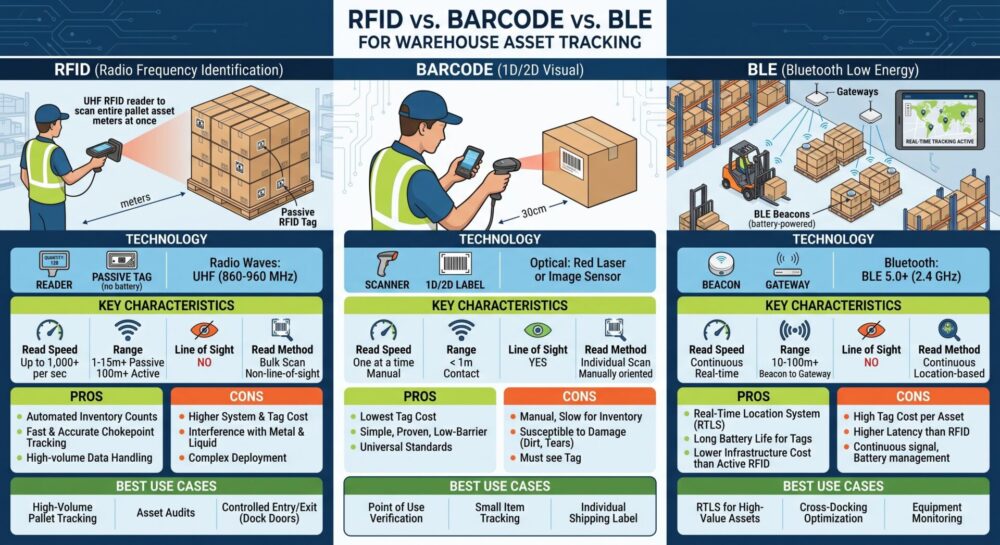
Direct answer: Barcode is lower cost and sufficient for low-volume, manually-scanned processes; RFID is better where high-volume, hands-free, bulk scanning materially speeds up operations.
Factor | Barcode | RFID |
|---|---|---|
Read method | Line-of-sight, one at a time | Radio frequency, no line-of-sight needed, bulk reads |
Labour requirement | Manual scan per item | Can scan dozens of tags simultaneously |
Unit cost | Very low (cents) | Higher (tags range from tens of cents to several pounds for specialist tags) |
Infrastructure | Handheld scanners only | Gateways/portals required at checkpoints |
Durability | Easily damaged, obscured, or unreadable if dirty | More robust; readable through packaging or light obstruction |
Best fit | Low-volume, cost-sensitive, simple pick/pack | High-throughput dock doors, bulk pallet counts, cycle counting |
The honest answer is that most warehouses don’t need to choose exclusively — many mature operations run barcode for item-level SKU tracking and layer RFID or BLE on top for asset- and pallet-level visibility. Treat this as a “which layer” decision, not a binary vendor choice.
When should a company use BLE instead of RFID?
Direct answer: Choose BLE over RFID when you need continuous or near-continuous location tracking across a wide area, want to avoid installing fixed gateways at every checkpoint, or need multi-year battery life without site visits.
BLE tags ping at set intervals and are picked up by smart gateways, vehicle-mounted trackers, or mobile devices — meaning coverage isn’t limited to fixed chokepoints the way RFID is. This makes BLE the stronger fit for:
- Tracking reusable assets (pallets, cages, kegs, containers) as they move freely across a large site
- Tool and equipment tracking, where knowing an asset’s general location — not just its last checkpoint — saves search time
- Sites where installing RFID gateways at every possible transit point would be cost-prohibitive or operationally disruptive
RFID remains the better choice when the requirement is genuinely binary — confirming an asset passed a specific, fixed point, such as a dock door or dispatch bay — and where sub-metre location precision at that single point matters more than continuous visibility.
How much infrastructure does warehouse RFID require?
Direct answer: RFID requires a physical reader/gateway installed at every location where a read is needed, plus cabling for power and network connectivity to each one — this is typically the largest cost in an RFID deployment, not the tags themselves.
Retrofitting an existing warehouse with RFID infrastructure means running cable to every gateway location. Cable-pulling costs can run roughly 10x the cost of the reader hardware itself, and installation often requires halting operations in the affected zone. Before approving an RFID project, get a clear infrastructure and installation cost line-item from any vendor — not just a per-tag price — since that’s usually where budgets are underestimated.
By contrast, BLE gateways are generally battery-powered and connect via cellular network rather than the local IT infrastructure, which removes the cabling requirement and much of the installation disruption. This is worth factoring into a total-cost-of-ownership comparison, not just an upfront capital comparison.
Should you implement RFID without a WMS?
Direct answer: It’s technically possible, but not advisable for most operations — without a Warehouse Management System (WMS) or equivalent software layer, RFID read events have nowhere to be interpreted, stored, or acted on in a way that drives operational decisions.
RFID (and BLE, for that matter) generates raw location and read-event data. On its own, that data doesn’t optimise a pick path, trigger a reorder, or flag a shortage — a WMS, or at minimum a dedicated asset-visibility platform, is what turns raw reads into maps, reports, and alerts that operations teams can actually use. If a WMS implementation isn’t imminent, it’s worth confirming that whatever tracking platform you choose includes its own reporting and alerting layer, rather than assuming raw RFID data will be immediately actionable.
How to choose: a simple decision framework
- Do you need continuous location, or just checkpoint confirmation? Continuous → BLE or active RFID. Checkpoint only → barcode or passive RFID.
- What’s your installed infrastructure tolerance? Can’t run new cabling or disrupt operations → BLE. Fixed dock doors are acceptable → RFID.
- What’s the asset value and volume? High-volume, low-value, simple tracking → barcode. Higher-value reusable assets needing loss reduction → BLE or RFID.
- Metal assets involved? Factor in on-metal RFID tag costs, or consider BLE, which doesn’t suffer the same signal degradation.
- Do you have a system to act on the data? No WMS or visibility platform in place → prioritise a platform decision before or alongside the hardware decision.
The bigger picture: there’s rarely a single “best” technology — the right answer is almost always use-case specific, and most mature warehouse operations end up running more than one technology layered together. As a vendor-neutral consultant, our job is qualifying which combination actually fits your operation before any vendor conversation happens.
Strategic Tracking helps enterprise buyers across pharmaceutical, logistics, manufacturing, automotive and food & beverage sectors qualify the right tracking technology for their specific use case, including BLE, RFID, and barcode-based solutions.