
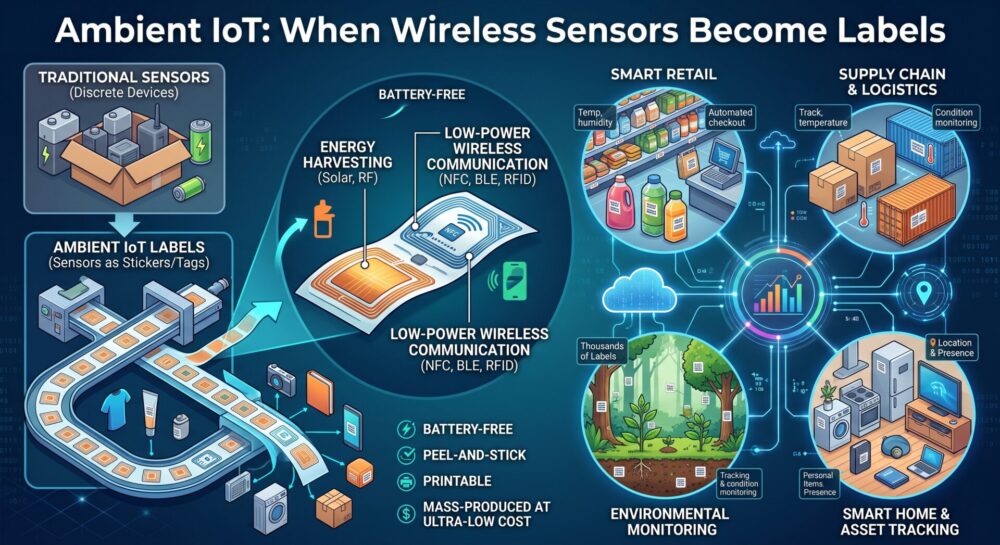
The Tracker That Sleeps but Still Answers
Welcome to Tracking Tuesday 1st September 2026.
The biggest tracking development this week was not a new GPS device.
It was a system designed to test battery-free wireless labels at up to 6,500 units per hour.
Wiliot and CISC’s partnership highlights the next challenge for ambient IoT: moving from impressive demonstrations to reliable, high-volume manufacturing.
For battery-free sensing to reach millions of products, cases and reusable assets, each device must be produced, tested, identified and applied with something approaching ordinary label economics.
This does not mean ambient IoT replaces cellular or satellite tracking.
It creates a wider technology hierarchy:
- RFID at controlled read points
- Battery-free BLE across instrumented environments
- Cellular smart labels for autonomous shipment monitoring
- Reusable cellular and satellite trackers for demanding journeys
This week’s Tracking Tuesday also examines satellite-IoT growth, infrastructure-light hospital RTLS and why pharmaceutical monitoring intensity should follow product and lane risk.
Ambient IoT’s next breakthrough is happening on the production line
Battery-free wireless labels have been demonstrated in shops, warehouses and supply chains for several years.
Their promise is compelling: attach inexpensive intelligence to products, cases, containers and reusable assets without adding a conventional battery-powered tracker to every item.
But proving that a wireless label works is not the same as producing millions of reliable labels.
The more commercially important questions include:
- How quickly can each device be tested?
- Can defective units be identified without slowing production?
- Can identity and test results be connected?
- What failure rate is acceptable?
- Can the device be applied through existing label-converting processes?
- What receiving infrastructure is required after deployment?
A new partnership between Wiliot and CISC Semiconductor provides evidence that ambient IoT is beginning to address this manufacturing problem.
New! Tracking Tech - Planning, Implementation & Best Practices for 2026
Based on 20+ years experience of implementing 100s of GPS tracking projects, we have written this easy-to-read best practice guide and checklist to help you plan and implement GPS tracking and realtime visibility solutions. Download Your Free 2026 Guide Here
Testing as many as 6,500 wireless labels per hour
On 25 August, Wiliot announced that it is working with CISC to advance high-volume production testing for Wiliot’s battery-free IoT Pixels.
CISC’s BLE Xplorer system is designed to verify the devices at speeds of up to 6,500 units per hour, per lane.
That is a company-provided maximum rather than an independently verified production result. Actual throughput will depend on test coverage, line configuration, failure handling and required traceability.
Nevertheless, the figure is strategically important.
Traditional asset trackers are manufactured and tested like electronic devices. Each unit contains a battery, circuit board, enclosure, identity and often a SIM or cellular profile.
Ambient IoT must ultimately behave more like the label industry. Individual devices may carry very little value, so testing cannot consume excessive time or labour.
If each label required even several seconds of manual handling, item-level deployment economics would quickly collapse.
Why production testing matters
A failed conventional tracker attached to a £50,000 shipment is inconvenient and costly. A small number of defective labels in a population of millions creates a different problem.
The system must distinguish between:
- A device that failed during manufacture
- A correctly functioning device outside reader coverage
- A device that was damaged during application
- A product that has genuinely not moved
- A signal that was detected but not forwarded
- An incorrectly associated digital identity
High-speed functional testing helps prevent manufacturing failures from becoming false operational conclusions.
This is particularly important when Physical AI or automated decision systems consume the resulting data. An AI system cannot compensate for a sensor population whose identities, performance and failure modes are poorly understood.
Supplier Quick Quotation Request
Does ambient IoT replace GPS trackers?
Not usually.
Battery-free BLE labels and autonomous cellular trackers solve overlapping but different problems.
An ambient device may be appropriate where:
- The number of items is extremely high
- Individual asset value is relatively low
- Battery maintenance is impractical
- Receiving infrastructure is available
- Approximate presence, movement or condition is sufficient
- The use case involves stores, warehouses or known logistics nodes
An autonomous cellular or satellite-connected tracker remains stronger where:
- A shipment must report independently
- Infrastructure cannot be installed along the route
- The cargo is high-value or time-critical
- Live intervention is required
- Precise outdoor location matters
- The route crosses multiple unrelated organisations
The likely future is not a single winning technology. It is a hierarchy of identification and sensing:
- RFID for low-cost identity and controlled read points
- Battery-free BLE for ambient, infrastructure-supported visibility
- Powered BLE for longer-range or more frequent signalling
- Cellular smart labels for autonomous shipment monitoring
- Reusable cellular or satellite trackers for demanding assets and journeys
Satellite IoT is moving into the same architecture
Omdia recently forecast that satellite-IoT connections could grow from 7.7 million in 2023 to approximately 197.7 million by 2035.
That is a forecast, not an installed-base guarantee. It nevertheless reflects major investment in low-Earth-orbit connectivity and cellular non-terrestrial networks.
Satellite connectivity is unlikely to make every inexpensive label globally reachable. Transmitting to space still affects antenna design, energy consumption, message frequency and cost.
Its most useful role may be as a fallback.
A device could use cellular networks in normal conditions, store data when no connection exists and send a short satellite message when a defined exception justifies the additional energy and cost.
This is particularly relevant to:
- Containers
- Trailers
- Remote industrial equipment
- Agricultural assets
- Maritime cargo
- Mining and energy operations
- Cross-border journeys with persistent terrestrial coverage gaps
The same principle applies indoors
Borda Technology is promoting a hospital asset-tracking pilot that uses compatible existing wireless access points.
The proposed trial covers 20 tagged assets for 90 days without installing a separate locating network.
The accuracy, compatibility and operational performance still need to be tested. But the commercial proposition is instructive.
Many tracking projects are prevented not by the tag price but by infrastructure, installation and integration.
A pilot becomes easier to approve when it:
- Uses infrastructure the customer already owns
- Covers a defined set of assets
- Runs for a fixed period
- Measures a specific operational outcome
- Avoids a large initial capital commitment
Industrial tracking vendors should pay close attention to the shape of that offer.
Pharmaceutical monitoring needs the same discipline
The industry’s growing access to inexpensive sensors does not mean every pharmaceutical shipment requires identical monitoring.
A sensible monitoring strategy should consider:
- Product value
- Stability profile
- Packaging qualification
- Lane and seasonal risk
- Number of custody handovers
- Delivery deadline
- Availability of replacement product
- Whether anyone can intervene
- Sensitivity of route or patient-linked data
A retrospective temperature logger may be sufficient for a stable product on a qualified lane when no intervention is possible.
A patient-specific cell-and-gene therapy shipment may justify continuous location, temperature, custody and escalation monitoring because delay or loss could make an irreplaceable treatment unusable.
Real-time data has value when it changes an operational decision.
That requires more than a sensor. It requires named recipients, thresholds, permissions, escalation workflows and agreed intervention actions.
The Tracking Tuesday verdict
Wiliot and CISC’s announcement does not prove that battery-free BLE labels are ready for every supply chain.
It demonstrates something more specific: ambient IoT is beginning to confront the industrialisation problem.
The winning tracking technologies will not necessarily be those with the most impressive laboratory specification.
They will be the ones that can be:
- Produced consistently
- Tested economically
- Applied using scalable processes
- Connected through realistic infrastructure
- Integrated with operational systems
- Trusted by people and automated decision tools
The moment a wireless sensor can be manufactured and handled like an ordinary label is the moment item-level supply-chain visibility becomes commercially much more plausible.
Strategic Tracking helps organisations compare shipment trackers, smart labels, RTLS and industrial asset-tracking technologies. We provide independent technology selection, pilot design and supplier research without tying the recommendation to one vendor.
Industry event radar
| Event | Date and location | Why it matters | Opportunity |
|---|---|---|---|
| Parcel+Post Expo | 23–24 September 2026, ExCeL London | Parcel monitoring, single-use labels, postal networks and e-commerce logistics | Attend / Network / Content |
| Cold Chain Live | 13–14 October 2026, Telford | More than 400 cold-chain executives and suppliers; strong condition-monitoring prospects | Attend / Network |
| IoT Tech Expo Europe | 19–20 October 2026, Amsterdam | Embedded IoT, Physical AI, connectivity, edge systems and digital twins | Supplier Research / Content |
| electronica | 10–13 November 2026, Munich | Sensors, batteries, antennas, semiconductors and electronics manufacturing | Supplier Research / Network |
| Pharmapack Europe | 27–28 January 2027, Paris | Connected pharma packaging, monitoring and disposable sensing; speaker application remains available | Attend / Speak / Partner Research |
| IoT Tech Expo Global | 3–4 February 2027, London | Local opportunity for enterprise-IoT partnerships and content | Attend / Network |
| Fruit Logistica | 3–5 February 2027, Berlin | Produce condition monitoring, cold chain and returnable packaging | Network / Content |
| Manifest | 8–10 February 2027, Las Vegas | Shippers, visibility platforms, investors and logistics technology | Partnerships / Content |