
The Autonomous Tipping Point
Welcome to this week’s Tracking Tuesday.
The industry is currently gathered in Orlando for the Gartner Supply Chain Symposium/Xpo 2026, where yesterday’s opening keynote confirmed a definitive pivot: we have officially entered the era of the “Autonomous Supply Chain.” Visibility is no longer the final goal; it is the raw fuel for Agentic AI systems that are beginning to resolve disruptions before humans even see the alert.
Gartner 2026: From Visibility to “Autonomous Business”
At the Gartner Supply Chain Symposium (May 4, 2026), analysts predicted that 60% of supply chain disruptions will be resolved without human intervention by 2031. The shift is driven by “Agentic AI”—systems designed to not just observe data, but to reason and execute decisions within guarded parameters.
The technical bottleneck is no longer sensor cost, but Connectivity Orchestration. As the IoT connectivity management market hits a projected $12.23 billion in 2026, the focus has shifted to the “Decision Stack.” This involves treating real-time telemetry from thousands of assets as a highly available resource, enabling AI agents to autonomously re-route diverted cargo or adjust production schedules without manual “triggering” from a human dispatcher.
“Autonomous business is moving from vision to reality… 8 in 10 executives expect it to dominate by 2030.” — Lindsay Azim, Senior Director Analyst, Gartner (May 2026).
If your visibility platform only provides “insights” for humans to act on, you are building a legacy system. The 2026 standard is Agentic-Ready Data—clean, high-frequency streams that allow AI to “observe, reason, and act.”
Smart Labels: The “Active Node” Evolution
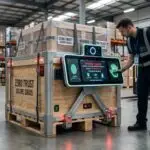
Fresh from recent logistics showcases and this week’s symposium, companies are redefining the label. Modern industrial printers are now viewed as “Intelligent Endpoints” rather than peripherals.
By embedding web servers and RFID verification directly into the printer, these “Active Nodes” register a package’s “Digital Birth Certificate” at the point of creation. When paired with new $8 printable cellular labels, we are seeing the end of the “Blind Pallet.” These labels don’t just sit there; they communicate via Bluetooth and 5G, feeding directly into the Agentic AI layers mentioned above to provide unit-level accountability from dock to door.
The Label is the Sensor. We are moving into a high-granularity era where item-level tracking is becoming a compliance requirement for pharmaceuticals and high-tech. Shippers must decide: will you own this unit-level data, or will you remain blind while your 3PL manages the narrative?
Supplier Quick Quotation Request
Edge AI: The 2026 Inflection Point
2026 marks the year Edge AI moved from pilot to mainstream. According to market data released in late April, the global Edge AI market has reached $61.8 billion, fundamentally changing the “operational physics” of the warehouse.
By processing data locally on the device (using Lightweight Neural Processing Units like Nordic’s nRF92/93 series), IoT sensors can now detect route deviations or temperature excursions in 10–50 milliseconds. This removes the latency of “round-trip” cloud handshakes and reduces cloud data costs by 60–80%.
Offline Resilience is Standard. In 2026, a “smart” sensor that stops working when the Wi-Fi or cellular signal drops is a liability. Edge AI allows for Continuous Auditability, where the device maintains its own security posture and buffers critical data until a secure sync is possible.
🌌 Idea for the Future: “The Autonomous Audit”
The Concept: A “Self-Healing” warehouse floor where Edge-AI enabled pallets and Cloud-Printers perform continuous, autonomous inventory reconciliation.
How it Works: Using the centimeter precision of Bluetooth Channel Sounding, pallets “handshake” with the Intelligent Printer Endpoints as they pass through the dock. If the Edge-AI on the pallet detects a mismatch (e.g., weight change or missing unit), it triggers the printer to autonomously generate a “Resolution Label” and alerts a robotic AMR to intercept the load before it hits the truck.
The Strategic Why: It eliminates the “Scan Gap” and reduces human auditing labor by 90%, moving the facility from reactive counting to Continuous, Self-Correcting Execution.
📅 Industry Calendar: Upcoming Events
Gartner Supply Chain Symposium/Xpo (May 4–6 | Orlando, FL): Must-Attend. Ground zero for VPs to discuss the transition from “Visibility” to “Autonomous Execution.”
ICRSCRM: Supply Chain Risk & Resilience (May 8 | Los Angeles, CA): The first major deep-dive into the Q1 CargoNet impersonation data.
ICL4DST: Logistics 4.0 (May 8 | New York, NY): Focused on integrating Triple-Mode hardware into legacy TMS.
CeMAT South East Asia (May 12–14, 2026 | Singapore): Critical for observing how these autonomous technologies are scaling in high-growth APAC corridor
Tomorrow’s Warehouse (May 14, 2026 | Coventry, UK): A tactical look at implementing Edge AI and RTLS in existing warehouse footprints.