What Is Bluetooth Asset Tracking? A Vendor-Neutral Guide to BLE, and When It Beats GPS, RFID and Wi-Fi Sniffing
Disclosure: Sensolus is one of our technology partners at Strategic Tracking. This article draws on a recent conversation between their marketing and product teams, but the comparisons and recommendations below reflect independent, vendor-neutral analysis — the kind we’d give any enterprise buyer evaluating a tracking technology, regardless of who supplies it.
What is Bluetooth asset tracking?
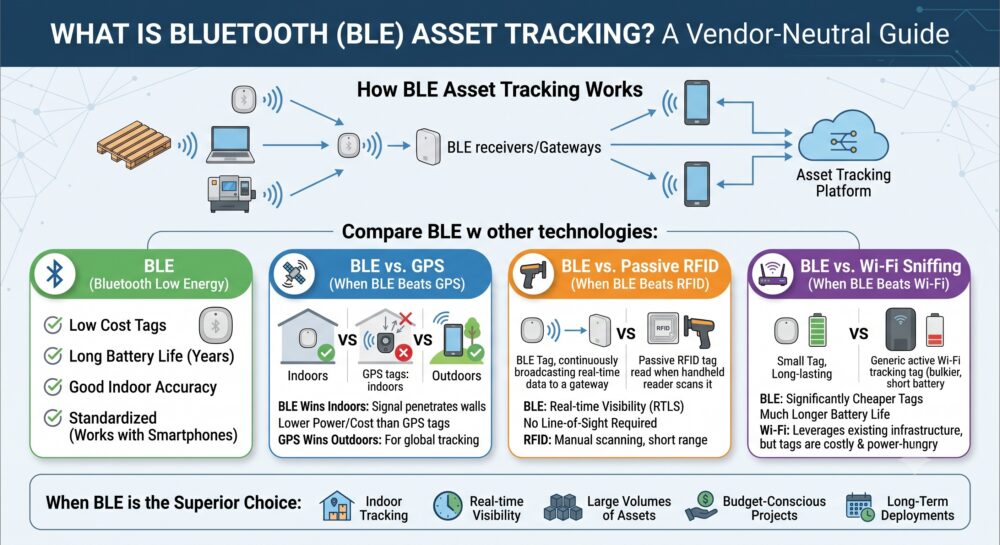
Bluetooth asset tracking (BLE tracking) uses small, battery-powered Bluetooth Low Energy tags attached to assets. Each tag emits a short signal — a “ping” — at set intervals. Nearby gateways, vehicle-mounted trackers, or smart trackers pick up that ping and relay the location data to the cloud, where it’s turned into maps, reports, and alerts.
Direct answer: BLE tracking is best suited to indoor and mixed indoor/outdoor environments where assets are small, numerous, or too low-value to justify a GPS tracker on each one — think tools, reusable containers, pallets, or moveable equipment inside a factory or warehouse.
How does BLE asset tracking compare to GPS, RFID, and Wi-Fi sniffing?
Enterprise buyers evaluating tracking technology are usually choosing between four core approaches. Here’s how they stack up:
Technology | Best environment | Typical battery life | Infrastructure cost | Key limitation |
|---|---|---|---|---|
GPS tracking | Outdoor only | Weeks–months (power-hungry) | Low (no gateways needed) | Doesn’t work indoors; too power-intensive for small tags |
RFID tags | Indoor, controlled chokepoints | Long (passive tags) | High — physical gateway needed at every checkpoint | Miss the gateway, miss the asset; cost multiplies per entry point |
Wi-Fi sniffing | Indoor | Short–medium (energy intensive) | Low if Wi-Fi already exists | Requires live connection to a positioning server; not viable on small tags |
Bluetooth (BLE) tags | Indoor and outdoor | 1–5 years, depending on configuration | Very low — no cabling required | Range limited (~20–50m); requires gateway or scanner coverage |
Apple AirTags / consumer crowdsourced BLE | Consumer, small-scale | Requires recharging | Low | Capped at 32 devices per account; not designed or licensed for business-critical operations |
Why this matters for buyers: the single biggest hidden cost in tracking deployments is rarely the tag — it’s the infrastructure. RFID gateways require cabling, and retrofitting a factory with cable runs can cost roughly ten times more than the installation itself, before accounting for the operational downtime of halting a line to do the work. BLE’s main commercial advantage is that gateways run on battery and cellular connectivity, avoiding both the IT network and the cabling bill entirely.
Why does infrastructure cost matter more than tag price?
Most procurement conversations start with “how much does a tag cost?” — but that’s usually the wrong question. The real cost driver is what it takes to read the tag.
- Cabled solutions (RFID gateways, wired sensors) require power and network runs to every scan point. In an existing facility, that’s disruptive and expensive — often 10x the equipment cost.
- BLE smart gateways are battery-powered and communicate over cellular, independent of the existing IT network. That means no cabling, no Wi-Fi dependency, and no operational downtime during installation.
- Remote, over-the-air configuration of BLE gateways means once they’re mounted, they rarely need a site visit again.
For any enterprise buyer building a business case, infrastructure and installation cost — not unit price — should be the first line item scrutinised in a vendor’s proposal.
Three real-world BLE asset tracking use cases
- Tool tracking in aerospace manufacturing (Airbus) Small BLE tags on hand tools used inside aircraft assembly lines solve two distinct problems: operational time lost searching for misplaced tools, and regulatory compliance — proving tools have been accounted for and removed from the aircraft before it leaves the factory. In aerospace, the cost of a single tool-related incident dwarfs the cost of tagging an entire tool inventory, which is why compliance-driven tracking cases like this tend to have the clearest ROI case of any BLE deployment.
- Warehouse cart tracking at scale (Vanderlande) Tracking over 1,600 carts across warehouse zones isn’t primarily a compliance exercise — it’s an operations optimisation one. The goal is understanding dwell time and movement patterns well enough to redesign pickup schedules. Manual counting was ruled out on two grounds: it’s labour-intensive, and staff doing the counting have no real incentive to flag their own shortcomings. Automated BLE tracking removes both problems and gives operations teams objective movement data.
- Integrating with existing scanning infrastructure (Ampere, logistics for JD.com) Where a fleet already carries standardised industrial handheld scanners — in this case Zebra devices already in delivery vehicles for route and address data — BLE tracking software can run on top of that existing hardware rather than requiring a separate scanning layer. Smart gateways are then added selectively, only in locations with weak coverage. This is a useful reminder that BLE tracking doesn’t always mean new hardware everywhere: integrating with infrastructure a business already operates can materially reduce deployment cost and complexity.
Is Bluetooth asset tracking right for your business?
BLE tracking tends to be the strongest fit when:
- Assets are numerous, moveable, and either indoor or mixed indoor/outdoor
- Asset value or use case doesn’t justify a full GPS tracker per unit
- Retrofitting cabled infrastructure isn’t feasible or would disrupt operations
- You need multi-year tag life without maintenance visits
It’s a weaker fit when assets are exclusively outdoors and need continuous live positioning (GPS remains the better tool there), or where sub-metre accuracy at fixed checkpoints is the primary requirement (RFID can still outperform BLE in that narrow case, despite the higher infrastructure cost).
The bigger picture: the “right” tracking technology is rarely a single-vendor, single-technology decision — most mature deployments combine BLE, GPS, and existing infrastructure depending on the asset class and use case. As a vendor-neutral consultant, that’s the conversation I have with every buyer before any vendor introduction happens.
Strategic Tracking helps enterprise buyers across pharmaceutical, logistics, manufacturing, automotive and food & beverage sectors qualify the right tracking and IoT technology for their specific use case — Sensolus included, alongside several other partners.