The Tracker That Sleeps but Still Answers
Welcome to Tracking Tuesday.
A GPS tracker that lasts six months is not automatically better than one that lasts two.
If the longer-life device is asleep and unreachable when the cargo disappears, what exactly has the extra battery life achieved?
This week’s Tracking Tuesday examines Queclink’s new GL330MG tracker and its attempt to balance low-power operation with on-demand reachability.
I also look at:
- Why shipping companies are questioning the treatment of consignments containing large numbers of small batteries
- IAG Cargo’s new pharmaceutical cold-chain station in Kuala Lumpur
- Menzies Aviation’s computer-vision cargo trial at Heathrow
The central buyer lesson is simple:
Don’t buy a battery-life figure. Buy an agreed level of visibility and response throughout the journey.
Why GPS tracker battery life is the wrong number to compare
Battery life is one of the first specifications most buyers examine when comparing GPS trackers.
One device promises 30 days. Another promises six months. A third claims several years.
The natural conclusion is that the tracker with the longest life must be the best choice.
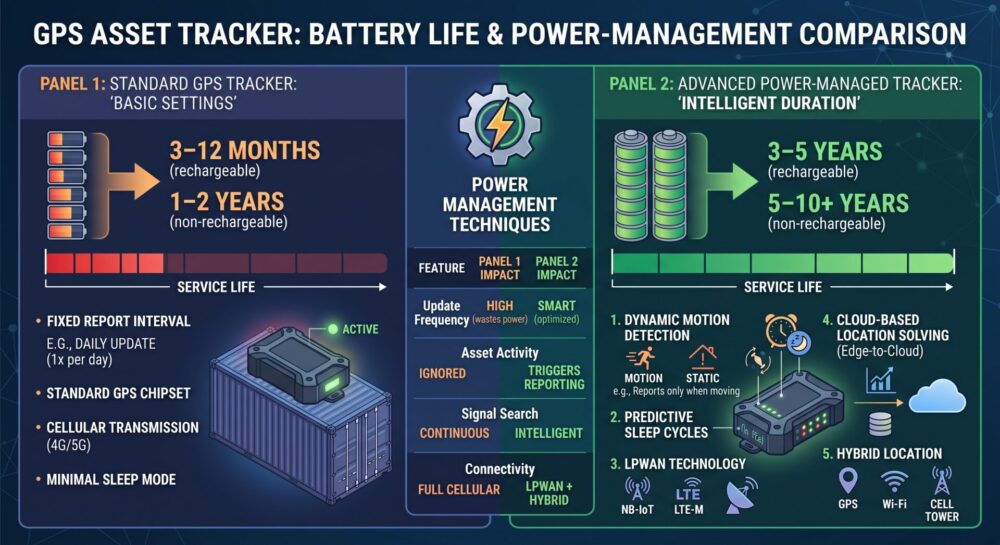
But battery life is not an isolated product feature. It is the result of choices about reporting frequency, network availability, positioning, sensors and how long the device remains asleep.
A tracker may achieve an impressive operating life by becoming unreachable for most of the day. That might be acceptable for recording asset movements or routine location updates. It becomes much less useful when cargo is stolen, a trailer disappears or an urgent shipment needs to be located immediately.
A new tracker from Queclink highlights a more commercially useful question:
Can the tracker conserve energy during normal operation but remain reachable when an exception occurs?
New! Tracking Tech - Planning, Implementation & Best Practices for 2026
Based on 20+ years experience of implementing 100s of GPS tracking projects, we have written this easy-to-read best practice guide and checklist to help you plan and implement GPS tracking and realtime visibility solutions. Download Your Free 2026 Guide Here
Queclink launches an online-on-demand tracker
On 18 August, Queclink announced the GL330MG, a rechargeable tracker aimed at freight, trailers, vehicles, cargo and mobile equipment.
The 95-gram device combines:
- Multi-constellation GNSS
- BLE 5.2
- Wi-Fi scanning
- Cellular connectivity
- Motion detection
- Geofencing
- An SOS button
- A 2,600 mAh rechargeable battery
Its most interesting feature is not its size or positioning technologies. It is what Queclink calls Smart Ping.
According to the company’s product announcement, enhanced eDRX technology allows the device to remain in an ultra-low-power state while still being available for a location request or remote command.
Queclink claims up to 1,500 hours—approximately two months—of online-on-demand operation with ten-minute scheduled reporting.
These figures need to be tested under real deployment conditions. Battery performance can change dramatically with mobile coverage, roaming, temperature, movement, GNSS acquisition time and the number of unsuccessful connection attempts.
Nevertheless, the architecture addresses a genuine tracking problem.
Why sleeping trackers become unavailable
Every battery-powered tracker has a finite supply of energy.
The device spends that energy on several functions:
- Waking its processor
- Detecting movement or reading sensors
- Acquiring a position
- Connecting to a network
- Transmitting data
- Listening for commands
- Repeating failed connections
Maintaining continuous contact with a cellular network consumes energy. Designers therefore place trackers into sleep modes between reports.
The deeper the sleep, the more power can be saved. The trade-off is that the tracker may not listen continuously for incoming requests.
If a device reports once every four hours, a platform may show the last known position while being unable to contact the tracker until its next scheduled wake-up.
That can be acceptable for some assets. It can be disastrous during a theft or route deviation.
Battery life should be expressed as a service level
Instead of comparing one headline number, tracking buyers should define the service they require.
A useful specification might say:
- Scheduled position every 30 minutes while moving
- Scheduled position every six hours while stationary
- Immediate wake-up following unexpected movement
- Temperature alarm within five minutes
- Remote location request answered within two minutes
- Minimum 45-day operating life under agreed coverage conditions
- Automatic reduction in reporting when remaining energy falls below a defined level
This describes what the tracker must achieve rather than asking suppliers to maximise a theoretical number.
The longest-life device may not provide the best service. It may simply collect less information.
Seven questions to ask about tracker power management
1. What reporting schedule supports the quoted battery life?
“Up to six months” is meaningless without knowing how often the tracker locates and transmits.
Ask for separate figures for stationary and moving operation.
2. Can the device be contacted between scheduled reports?
Determine whether the tracker is continuously reachable, periodically reachable or completely unavailable while sleeping.
3. How quickly does it answer an on-demand request?
“On demand” could mean seconds, several minutes or the next scheduled network window.
The acceptable delay depends on the use case.
4. What happens in poor coverage?
Repeated network registration and data-upload attempts can consume more energy than successful transmissions.
International and cross-border deployments should test roaming as well as good domestic coverage.
5. How is indoor positioning handled?
GNSS performance deteriorates inside metal trailers, warehouses and covered loading bays.
Queclink addresses this by adding Wi-Fi scanning and BLE. Other products may use cell location, gateways or last-known-position logic.
Buyers should understand which location source appears on the platform and the accuracy it provides.
6. Does the tracker respond differently to risk?
A good power strategy should not treat every moment of a journey identically.
The device may need more frequent reporting:
- Near a high-risk collection point
- After unexpected movement
- During a route deviation
- When a door or light sensor is triggered
- Close to the delivery deadline
- Following a temperature excursion
7. What happens when the remaining energy becomes low?
A tracker should preserve enough energy to provide useful evidence at the end of the journey.
Increasingly frequent low-battery messages can be counterproductive if they consume the remaining power. Buyers should ask how the device and platform prioritise final transmissions.
Supplier Quick Quotation Request
Small batteries are also attracting safety scrutiny
Power management is not only a runtime issue.
On 24 August, the Financial Times reported that shipping organisations are pressing the International Maritime Organization to reconsider rules affecting consignments containing large numbers of small lithium batteries.
Under Special Provision 188, qualifying small cells and batteries can benefit from exceptions from some dangerous-goods requirements. The concern is that a container filled with individually small batteries may represent a substantial combined fire load without being declared, segregated or positioned for emergency access in the same way as declared dangerous goods.
This story concerns aggregated shipments of products such as consumer electronics—not one small tracking device attached to a package.
But it provides an important warning for the smart-label market.
A disposable tracker may contain a small amount of stored energy. A shipment of thousands of trackers is a different operational proposition.
Buyers and distributors should therefore examine:
- Battery chemistry
- UN 38.3 test evidence where applicable
- Safety data
- Activation state during transport
- Protection against accidental activation
- Quantity per carton
- Storage conditions
- Transport by air and sea
- Disposal and damaged-device procedures
Non-lithium battery architectures may gain an advantage, particularly for high-volume labels intended for air freight. But “non-lithium” should not become a substitute for complete technical documentation.
Cold-chain infrastructure expands in Southeast Asia
IAG Cargo has added Kuala Lumpur International Airport to its Constant Climate pharmaceutical network.
The GDP-certified Kuala Lumpur facility can handle active and passive temperature-controlled shipments. It connects with London Heathrow through a daily service and becomes the thirteenth approved Constant Climate station in Asia-Pacific.
IAG Cargo now operates approximately 100 approved stations globally.
This is a positive infrastructure development, but an approved origin and destination do not eliminate monitoring requirements.
Pharmaceutical shipments may still pass through:
- Road collection
- Export handling
- Security and customs processes
- Ramp exposure
- Aircraft loading
- Heathrow transfer
- An onward flight
- Import clearance
- Final-mile delivery
The value of an independent monitor is that it records what happens across organisational handovers rather than within only one carrier’s controlled facilities.
Physical AI begins observing cargo directly
Menzies Aviation has also started a computer-vision trial with CIND at Heathrow.
The system measures pallets as they move through the warehouse and creates a real-time visual model as cargo is built onto an aircraft Unit Load Device.
It can capture or evaluate:
- Pallet dimensions
- Weight
- Stackability
- Shipment references
- Aircraft-contour compliance
- Overhang and loading issues
This demonstrates that visibility data does not always need to originate from a device attached to the shipment.
Fixed cameras, scanning portals and handling systems can generate valuable observations at warehouses and airports. Attached trackers remain valuable between those controlled points.
The strongest visibility architecture may therefore combine:
- Fixed infrastructure at known facilities
- Carrier and handling-system events
- Shipment-level cellular or BLE devices
- Condition sensors
- A platform that normalises the resulting data
Tracking Tuesday verdict
The important innovation in tracking is not simply a larger battery.
It is more intelligent control of finite energy.
Tracking buyers should define:
- When the device must report
- When it must remain reachable
- Which events justify additional energy use
- How the device behaves in poor coverage
- What evidence must be preserved
- How the battery is transported and eventually handled
Queclink’s new tracker should be assessed against those criteria rather than accepted solely on its claimed two-month operating life.
The wider market lesson is equally important:
Do not buy battery life. Buy an agreed level of visibility and response throughout the journey.
Strategic Tracking provides independent advice on shipment trackers, smart labels, industrial asset tracking and multi-provider visibility. We help organisations define the use case, compare technologies, design pilots and evaluate whether the device, connectivity and platform can deliver the required operational result.
Industry event radar
| Event | Date and location | Why it matters | Opportunity |
|---|---|---|---|
| Parcel+Post Expo | 23–24 September 2026, ExCeL London | Closest match for parcel monitoring, disposable labels, carrier visibility and e-commerce logistics. Registration is open; the supplier pass remains at the early rate until 23 September. | Attend / Network / Content |
| Cold Chain Live! | 13–14 October 2026, Telford | More than 400 UK cold-chain operators and suppliers; strong monitoring, food, pharma and data-led logistics prospects. | Attend / Network |
| IoT Tech Expo Europe | 19–20 October 2026, Amsterdam | IoT connectivity, embedded systems, edge AI, physical AI and digital twins. | Supplier Research / Content |
| electronica | 10–13 November 2026, Munich | Battery, antenna, sensor, printed-electronics and contract-manufacturing relationships. | Supplier Research / Network |
| Pharmapack Europe | 27–28 January 2027, Paris | Pharma packaging, connected devices, cold-chain monitoring and disposable sensors. A speaker application page is currently live. | Attend / Speak / Partner Research |
| Fruit Logistica | 3–5 February 2027, Berlin | Fresh-produce monitoring, reusable packaging, spoilage prevention and cold-chain technology. Visitor tickets become available in September. | Network / Content |
| Manifest | 8–10 February 2027, Las Vegas | Major shipper, logistics-platform, investment and technology audience. | Content / Partnerships |