A construction company may own excavators worth tens of thousands of pounds, trailers, generators, breakers, buckets, compactors, surveying equipment and hundreds of smaller tools.
They are all “assets”.
They should not necessarily all be tracked in the same way.
That is one of the biggest mistakes organisations can make when considering construction equipment tracking.
A supplier demonstrates a GPS tracker. It looks impressive. A map shows every device. Geofences generate alerts.
The temptation is to ask:
How much would it cost to put one on everything?
A better question is:
Which assets create enough operational or financial pain when they are missing, unavailable or underused to justify better visibility?
Don’t start with the tracker.
Start with the problem.
What problems can construction equipment tracking actually solve?
Construction equipment tracking can help locate mobile plant, reduce search time, identify unauthorised movement, improve equipment utilisation, understand site inventory and provide better evidence about where equipment has been deployed. The business case depends on the asset and workflow rather than simply knowing its position on a map.
The obvious use case is theft.
It is an important one. UK police crime-prevention guidance recommends tracking systems as one element of plant security because movement notifications can support a prompt response. The same guidance also recommends physical security, immobilisation, identification and accurate equipment records: tracking should therefore be treated as one layer of a broader security strategy rather than a guarantee against theft.
But theft can overshadow the everyday operational case.
Construction businesses repeatedly need to answer questions such as:
Where is the breaker attachment?
Which site has the generator?
Did the hired unit come back?
Which machines haven’t moved recently?
Is the trailer still at the customer site?
Did equipment leave an authorised area?
Are we renting additional equipment while our own assets are sitting unused elsewhere?
That is where location data can start becoming management information.
Should every piece of construction equipment have a GPS tracker?
No. Tracking every asset with the same technology can create unnecessary hardware, connectivity and management cost. Track assets where better visibility changes an operational decision, and match the tracking method to asset value, mobility, power availability, environment and required reporting frequency.
Consider four very different assets:
| Asset | Likely requirement | Potential approach |
| £80,000 excavator | Location, movement, utilisation, security | OEM telematics or powered GPS/cellular |
| £6,000 breaker attachment | Location between sites, custody, loss reduction | Long-life autonomous tracker |
| £600 specialist tool | Site/van inventory, search reduction | BLE, RFID or controlled check-in/out |
| £20 hand tool | Identification/accountability | Barcode/QR/RFID may be sufficient |
The prices are illustrative rather than thresholds.
The important point is that the business case changes dramatically across the fleet.
A £20 consumable tool rarely justifies an independently connected cellular tracker.
A high-value excavator may already have sophisticated OEM telematics, making another device redundant unless a separate security requirement exists.
Between those extremes is a large and commercially interesting category of assets that are valuable, mobile and operationally important but don’t have a convenient onboard data connection.
GPS or BLE: which is better for construction equipment?
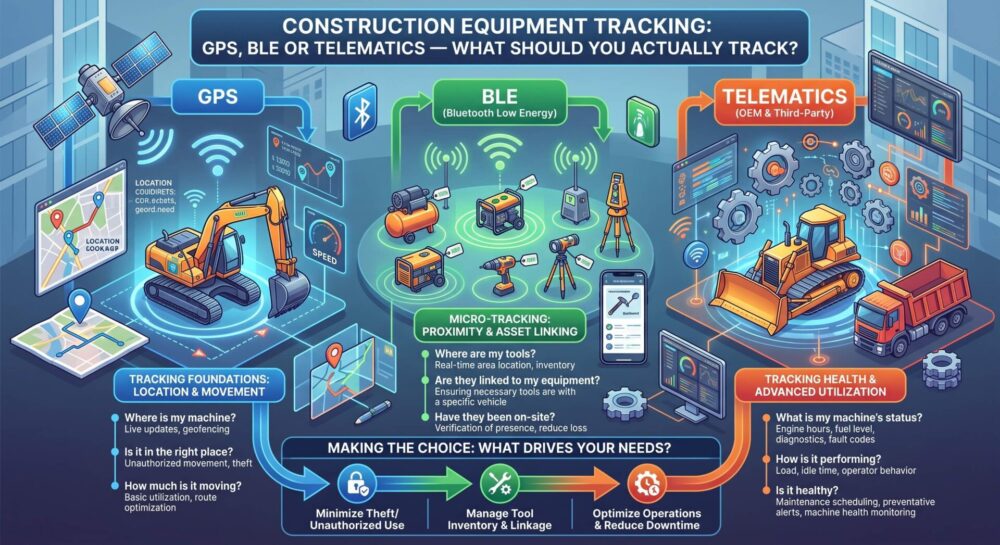
GPS/GNSS with cellular communications is generally better suited to valuable assets moving across uncontrolled outdoor locations. BLE is generally better suited to larger populations of smaller assets where compatible gateways, vehicles or smartphones can detect tags. Hybrid deployments can use both.
This distinction matters.
GPS/cellular
An autonomous tracker can determine or estimate an asset’s location and communicate over a wide-area network.
That can suit:
- excavator attachments;
- generators;
- compressors;
- trailers;
- towable equipment;
- rental plant;
- specialist machinery.
But reporting frequency matters.
A battery-powered tracker sending frequent positions consumes more energy than one waking after movement or reporting periodically.
For a non-powered asset expected to remain in service for years, reporting strategy is part of the product design.
Bluetooth Low Energy
BLE tags can be much smaller and potentially cheaper.
They are useful where another device can hear them.
That might be:
- a gateway in a depot;
- a gateway inside a van;
- a smartphone;
- fixed infrastructure at a tool store;
- another compatible receiver.
Bosch’s current construction architecture illustrates this division: it positions GPS-capable hardware for larger machinery and BLE beacons for smaller tools, with gateways providing the surrounding infrastructure. That is a company implementation example, not evidence that every construction deployment should use the same architecture.
What about existing machine telematics?
Check what data your powered equipment already produces before installing additional trackers. Many modern machines and rental fleets already have OEM or telematics systems capable of reporting location, utilisation or operating information. The problem may be consolidating those feeds rather than installing more hardware.
This is an increasingly important procurement question.
A mixed construction fleet might contain machines from six manufacturers plus hired equipment.
Buying another tracker for every machine may duplicate existing capability.
The more interesting problem becomes:
How do we create one useful operational view from several sources?
GAP Group provides a current example of this model: it says its GAP Track environment integrates feeds from multiple OEM systems into one fleet-management interface.
The principle extends beyond construction.
Sometimes the best tracking device is the one already fitted.
What about attachments?
Attachments are an especially interesting tracking problem.
Buckets, breakers, augers, grapples and other attachments may:
- have meaningful capital value;
- move between machines;
- move between sites;
- sit unused for long periods;
- have no permanent electrical supply.
They therefore behave differently from the powered machine carrying them.
Tracking the excavator doesn’t necessarily tell you where the breaker that was removed three days ago is now located.
For these assets, the questions become:
How quickly do we need to know it moved?
Do we need exact coordinates or simply site-level presence?
Can a gateway infrastructure detect it?
How many years should the battery last?
Can the tracker survive the mounting location?
Those questions should drive technology selection.
Is “real-time GPS” always necessary?
Usually not. The appropriate reporting frequency is determined by the decision the business needs to make. A security-sensitive asset may justify rapid movement alerts, while an attachment that normally remains on one site for weeks may only need movement, arrival or periodic inventory events.
“Real time” sounds desirable.
It has a cost.
For battery-powered equipment, more frequent communication generally means greater energy consumption.
It can also create huge volumes of data that nobody acts upon.
If a stillage moves twice a week, knowing its position every 30 seconds provides little additional operational value.
The same logic applies to construction assets.
Ask:
How late can this information arrive before it stops being useful?
That is a better specification than “we want real-time tracking.”
Can tracking stop construction equipment theft?
Tracking can improve detection and recovery opportunities, but it should not be presented as preventing theft by itself. Physical security, immobilisation, identification, site procedures and rapid response remain important. A tracker is most valuable when movement information triggers an effective operational response.
This distinction is important.
A geofence alert at 02:17 is only useful if:
- it reaches the right person;
- the movement is genuinely suspicious;
- someone knows what action to take;
- the location remains sufficiently useful for a response.
That makes alert design and escalation part of the tracking solution.
Not merely the hardware.
How should a construction fleet decide what to track?
Use a simple five-stage qualification process.
1. Identify the operational pain
Is the problem theft, search time, equipment availability, rental cost, custody, utilisation or maintenance?
2. Segment the assets
Group assets according to:
- value;
- mobility;
- onboard power;
- frequency of movement;
- operating environment;
- replacement lead time;
- operational consequence of absence.
3. Define the decision latency
Do you need to know within:
- minutes;
- hours;
- one shift;
- one day?
4. Select the minimum viable visibility
Does the business require:
- identity only;
- depot/site presence;
- last-seen location;
- movement alerts;
- periodic outdoor location;
- frequent live position;
- utilisation/engine data?
5. Calculate the business case
Compare tracking cost against measurable costs such as:
- replacement;
- hire;
- search labour;
- idle fleet;
- unnecessary purchases;
- project delays;
- administration.
Only then select technology.
How should you run a construction equipment tracking pilot?
A pilot should test a representative mix of assets and difficult operating conditions rather than simply demonstrating dots on a map. Establish baseline costs and success measures before installing hardware.
For example, choose:
- several powered machines;
- several unpowered attachments;
- a trailer;
- smaller tools;
- at least two operating sites.
Test:
- mounting;
- cellular coverage;
- BLE detection;
- movement alerts;
- battery behaviour;
- site arrival/departure;
- false alerts;
- dashboard workflow;
- API integration;
- user response.
Then measure whether visibility changed decisions.
Suggested pilot measures
| Measure | Baseline | Pilot question |
| Search time | Hours/month | Did searches decrease? |
| Missing assets | Units/month | Did unexplained loss decrease? |
| Emergency hire | £/month | Did better availability reduce hire? |
| Idle equipment | Asset-days | Could assets be redeployed? |
| Inventory accuracy | % | Did location data improve certainty? |
| Alert response | Minutes | Were exceptions actionable? |
Strategic Tracking Verdict
Construction equipment tracking should be treated as an asset-visibility architecture, not a bulk purchase of GPS trackers. Powered plant may already provide useful telematics; valuable unpowered equipment can justify autonomous tracking; smaller tools may be better served by BLE, RFID or simple identification. Segment the fleet first, define the operational decision each asset requires, and deploy the least complex technology capable of delivering it reliably.
FAQ
What is construction equipment tracking?
It is the use of telematics, GPS/GNSS, cellular trackers, BLE, RFID, identification technologies and software to improve visibility of construction plant, tools, attachments, trailers and other mobile assets.
Can you GPS-track excavator attachments?
Yes. Battery-powered autonomous trackers can be fitted to suitable attachments, subject to mounting, RF performance, impact exposure, environmental conditions and required battery life.
How long will a battery-powered equipment tracker last?
There is no universal figure. Battery life depends on device design, battery chemistry, reporting frequency, movement, temperature, signal conditions and sensor use. Assess battery life against the intended configuration rather than a headline maximum.
Is BLE suitable for construction sites?
It can be. BLE is particularly useful for tool and equipment populations where gateways, vehicles or smartphones provide sufficient detection coverage. It should not be assumed to provide autonomous wide-area location.
Can equipment tracking reduce rental costs?
Potentially. Better location and utilisation data can reveal owned equipment sitting idle while another unit is being hired, but savings depend on whether the organisation actually uses the data in planning and procurement.
Should I add trackers to machines with OEM telematics?
Not automatically. First determine whether the existing system already provides the location and utilisation information required. Integration may be more useful than duplicate hardware.
Can GPS tracking prevent theft?
It can support detection and recovery, but tracking should form part of a wider security process incorporating physical protection, identification, immobilisation where appropriate and a defined incident response. UK crime-prevention guidance supports this layered approach.
How many assets should be included in a pilot?
Enough to represent the important asset classes, sites and operating conditions. The objective is not statistical volume for its own sake; it is to expose the architecture to realistic workflows and difficult conditions before rollout.
CTA
Not Sure Which Construction Assets Are Worth Tracking?
Strategic Tracking can help segment your equipment fleet, identify the operational problem, evaluate GPS, cellular, BLE and other approaches, and design a controlled pilot before you commit to a large deployment.
CTA: Discuss Your Construction Equipment Tracking Requirement